Pages

Showing posts with label black hole. Show all posts

20140112

There has been an error

An error of some sort was required to create everything you see. For, there was matter and antimatter, and theoretically these two should cancel each other out, and yet they do not. By like 0.000001% for reference. But that 0.000001% was enough to create our entire Universe. Every star, every galaxy, every black hole, the sum remainder of an unfinished math set.

Imperfection is the source of Creation.

This being true, should we judge those who make mistakes? Or systems that crash?

Like this digital billboard with a Windows error in the fog?

20130121

Lunar Coda

Luna and Venus - they're old friends in the sky. By David Cortner.
From the ISS. Look how thin our atmosphere is! All it would take is a big gust of solar wind from the sun to blow it all away, and there's nothing we could do to prevent it. We'd know it's coming a few days in advance, so I suppose bunkers could be stocked and whatnot, but surely, t'would be our doom.
Hurricane Emily, also from the ISS. Wouldn't it be awesome to be the official photographer on board - like, that was your job? All the other astronauts gotta turn nobs and shit while you just snap sweet pics all day/night - which occur like every hour.

Behold the power of the storm - precisely the same form we theorize blackholes to possess, if you could imagine it in 3 dimensions rather than the 2 here (A sphere as opposed to a plane). All points rotate towards the center due to the enormous change in pressure - low pressure, man. Real low. The lowest - and so all things fall towards it, increasingly fast as you get closer to the center. Speed causes heat and heat is energy which does work. Or, in this case, flip a ton of shit over.

Also, yay President Barack Hussein Obama!
In the fight against insanity and outright nihilism, Bronco Bamz is our greatest fighter, and deserves all our support. As you can see, even Luna supports BHO - so should you! That is, if you stand against nihilism. Some don't. They suck. 27%

20120320

#Occupy Jupiter

It's true. Jupiter is far bigger than all the other planets put together. Its system of moons and smaller moons and more little tiny moons is its own planetary system. For you see, Jupiter could have been a star. Just a bit more mass, a little more spinning, and fusion would have lit. But alas, not enough gas, Jupiter was kicked out of Stellar U and now must walk among we, the discarded. But as a King, Boss Hogg of Sol's System.

And this is the chain of our existence. Dig it: From quarks and electrons, joining to form atoms, atoms joining to form molecules, molecules joining to form complex bonds, and based on their composition, we have our world and everything in it - rock, water, air, tree, you, me, even your pee. Complex groupings of molecular bonds.

Now, above you and me is space, vast and full of everything. Great, gigantic clouds of hydrogen light years long start to spin, perhaps disturbed by a nearby nova, and in the spinning the denser material falls towards the center of the spiral in ever increasing mass, causing ever greater heat, so on and such until there is a new joining, a new bond: Fusion. And fusion produces pretty much all of the energy you see around you. That makes you up. Energy and matter is our reality.

But fusion is not the end, for when the supernova collapses it can go one of two ways: A neutron star - a tripped out ball of neutrons (no atoms) spinning so fast yet so regularly they can be used as interstellar clocks. No bigger than Manhattan, they are denser than our entire solar system.

OR, a Black Hole.

Which is the ultimate break with this reality of ours - for everything goes in, the BH can get bigger or smaller, quieter or more active, like a "thing", but all of the energy and matter that falls in to it appears gone, into nothingness - for there is no such thing as a Black Hole, just its effects on gravity. The so called "Singularity" at the center of a Black Hole is just a placeholder word, since no one has any real idea. Our physics says it is of zero space yet infinite mass, which is absurd. You can't measure it directly, since it is literally a hole - everything falls through. And so either our mathematical theories are wrong, or we just don't have a clue. Yet. Science will find a way, eventually.

So, from electron to Black Hole and everything in between - this is our reality from start to end and swirls so large and endless around us, be of good cheer, for you are here, in this amazing grace, able to appreciate it. From time to time. Ramen.

20111003

Down is Up (Up is Down)

Look deeply into the ever turning gyre, and soon enough you can't tell if you're going down or up. And so is the very nature of reality - down, up, fast, slow, these are all relative terms. In fact, this is part of Einstein's theories of relativity, which states (in part) that all motion, all direction, is always relative to the observer. There is no other way to define it. Up is up to you, up could be something different to someone else from a different perspective. Another example - right now, every human on this Earth is flying through space at many thousands of miles per hour. Does it seem that way to you? No, because we are so small relative to the size of the Earth that we don't notice the spinning and the hurtling. It's much bigger than us.

And so with that, here's an interpretive graph of a black hole:
In 3 dimensional space (4 dimensional really, but lets not overly complicate things), the black hole sits at the center of a sphere, and towards its two poles matter and energy falls. Now, what happens at this center - the Singularity which is the black hole - no one has any idea what happens. It's all educated guesses and no one feels confident about any of them. I am confident, however, that the black hole is key to our Universe and understanding it will allow us to understand so very much more. Note - I spend a lot of time thinking about black holes, like an itch I can't stop scratching, because something is big there. Something important. How can all that matter and energy get compressed to... nothing? Something's missing. Finding it will unlock the next game level.
I'm not the only one, of course, spending a lot of time thinking about black holes. Cosmology in large part is now focused on them, since, again just for an example, a massive black hole sits at the center of every galaxy, leading one to wonder - is the black hole necessary for galaxies? Are galaxies in fact nothing but the environments created by black holes? It's possible! Black holes could be very, very tiny too - microscopic black holes might exist all around us, popping into existence and popping back out, the quantum fizz in our effervescent existence. As with all things in this reality, the big is reflected in the small, the small in the big, and scientists are finding that water can be used to simulate many of the effects of black holes. Above, the ocean vortex. Imagine another vortex meeting this one from the bottom of the sea, and you have a black hole effect.  Many things can be learned by these simulations, one of which is - look at all the water that avoids the vortex (black hole)! Most of it. Ergo, black holes are no single minded monsters of destruction, but rather they are fundamental to our Universe. Take a look at a cross section:
Only a small percentage of the matter and energy drawn towards a black hole actually goes into the black hole. The rest is spun around, heated up, and thus causes rotation on large scales (i.e. galaxies spinning) and create stars upon stars upon stars - the first star, perhaps, was birthed by a black hole.

So, shed any old notions you might have had about big bad evil black holes. They are, in fact (theory!), the very engines of our Creation, and the greatest mystery that exists today. 

Solve the Singularity!

20110117

The Story (as of today)

Here it is:


A long, long time ago there was something like a point, but not really, of infinite mass and zero space. And then it began to expand, and then really expand (Inflation Theory), and in those first few moments, all the building blocks for our Universe were created in a crescendo of matter-antimatter collisions, with but .00001% of matter surviving, and that small remainder is everything. 


With ever further expansion came cooling and with that matter condensed out of energy, and then matter joined with matter to make a nucleus, which caught an electron, and an atom was born. Hydrogen and Helium filled the universe in great clouds, swirling and twisting with the currents of energy rippling through space, and over hundreds of thousands of years these great clouds condensed down into hot swirling points and BAM! The first stars were born, giant monsters living and dying in a few thousand years and then BAAAMMM! A massive explosion, and the first stellar Black Hole is born, and begins eating, pulling everything towards it. And this relentless pull pushes more clouds of hydrogen and helium to condense, creating stars and stars and ever more stars, some of these giving birth to more Black Holes, which start to merge, growing ever larger, ordering more and more clutches of stars in orbit around them, and the first galaxies were born.

Stars of hydrogen and helium create ever heavier metals, like carbon and oxygen, nitrogen and lithium, and this second generation of stars creates ever more heavier metals, like Iron, and in the biggest explosions of stars, everything denser than Iron is created in an instant - gold, silver, uranium, etc.  And we - life - is made up of these heavier metals. Iron courses through our very blood, and there is only one place in existence where Iron is created: A star.


Life spawned on one planet orbiting one star in a vast sea of billions of stars in billions of galaxies in maybe billions of Universes, and spread from the sea to the land. Evolution relentlessly shaped forms and functions through success and many millions of years later, here we are, you and I, contemplating it all. Brains made of up of hundreds of billions of neurons communicating electronically over a galaxy of connections, producing these very words that I type, you read, you and me - made of this very Universe, with a mind able to wonder why.


We live in an infinite sea of realities, dimensions and times beyond our comprehension and yet still, we can strive and imagine, this fantastic existence we call ours: Blessed to live in this, the Golden Era.


For our future is grim; the earth will be burnt and destroyed hundreds of times over; our galaxy will merge with Andromeda, sending each into a chaos lasting a billion years, and many, many billion more, space will be so stretched out there will be no stars in the night sky, as all matter is so far apart from other matter that there is, nothing. Stretched to infinity, cold and dark and eternal, as time will stop, motion will stop, the credits will say: Fin.


But that is all meaningless other than in a poetic way: We are here, now, alive and able to ask, Why? And "Why?" is the most powerful force ever released in this grand play.

Large Hadron confider

Here's an older pic - but still awesome - of the LHC (Large Hadron Collider) at the CERN institute. For my money, CERN is the most excellent place on Earth, since its a pure research endeavour aimed at pursuing the biggest questions. Funded mostly by the EU, but with some American aid. Alas, most of the USA R&D budgets these days go to one thing and one thing only: WAR! And military research.

For you wags: A hadron is the name given to a subset of composite particles, made up of baryons and mesons. You in fact now some baryons right now - the proton and the neutron. 

The idea behind a particle accelerator is quite simple: You send some particles one way, and some the opposite way, around a loop. Spin them up faster and faster till they get close to the speed of light, then smash them together. The energy released by this collision creates - for an iota of time - particles that we can never normally see. Particles that would have been created in the early Universe, before it cooled and spread.

Thus, the importance of LHC experiment (please note there are many more experiments going on at CERN than just the LHC, though the LHC is the big one): It's the biggest collider in the world, and thus can generate more speed; more speed equals more energy, and with more energy comes the brief creation of particles closer and closer to the Big Bang.

Thus, it's an attempt to recreate the conditions of the Big Bang.

I mentioned below the importance of the Higgs Boson in all this - to wit: Theory states it is this Higgs Boson that gives mass to everything. Think of the Higgs Boson as a field of grass - some objects pass through the grass like it's not there. In this analogy, these objects have no mass - like Photons; other objects get slowed down by the grass, and we call this slowing down "mass". You, for instance.

Hitherto, the Higgs has never been detected. Theory only. It is the LHC which will allow us for the first time to see it. Or not.

Now, you may have heard the doomsayers declaring the LHC would destroy the world by creating a small Black Hole, which would quickly grow and then consume the Earth, then the Solar System, etc.


But this is patently ridiculous, as there's not nearly enough energy to do so; plus, if microscopic black holes do indeed exist, than they exist right now, all around us, and haven't seemingly destroyed us yet. So, pshaw to that theory! Though it would make a fun Sci-Fi disaster movie.


But I suppose it is possible that not only will the LHC discover the Higgs, but microscopic Black Holes as well. 

in the middle of it all


Perhaps I misspoke earlier, when stating there is no middle - no center of the circle. We're not it, and nothing we could ever know is it. But rather, the middle is found at the Black Hole - the endpoint of gravity. And that's all a Black Hole is - an extreme point of gravity. And like fusion, like feezing, like gas, it's a phase change in reality - our reality.

I've gone on and on about Black Holes before, so I'll keep it brief - Black Holes are the shiznit, man. The end all/be all. Perhaps there are micro-black holes all around us as matter/antimatter in the quantum fizz annihilates and for a brief moment, a super tiny Black Hole.

Black Holes mostly come in the size of twenty or so NYC blocks. But they can merge with other Black Holes and grow larger, and larger, and ever larger. And in the early Universe, with the first massive stars exploding were born the first massive Black Holes, and they grew, and drew all the random gas and whatnot around them, in an orbiting embrace, and thus was born the first galaxies, our reality to this day.

As I've said in previous posts, gravity slows down time. Dig it, for it's true. And a Black Hole is the ultimate point of gravity - in fact, the Black Hole, the Singularity, is defined by infinite gravity in zero space. For now.

And so time stops at the Black Hole - it ceases to exist as a moving reality. So, if we were able, somehow, to launch a probe to a Black Hole, and it were able to survive the incredible ripping forces around the Black Hole and fall into it, we would see it enter the Black Hole and stop, forever.

All information is frozen on the surface of a Black Hole, never to change. Like a hologram.

And so, in conclusion for now, a Black Hole sits in the middle of our reality - existing at a macro scale and shaping events at scales beyond our feeble minds. Yet at the same time the master of the small, taking all energy and matter and shredding it, adding it to its mass, a frozen hologram of information breaking the very fabric of quantum space.

It's deep, brutha.

20101210

Black Hole Suns

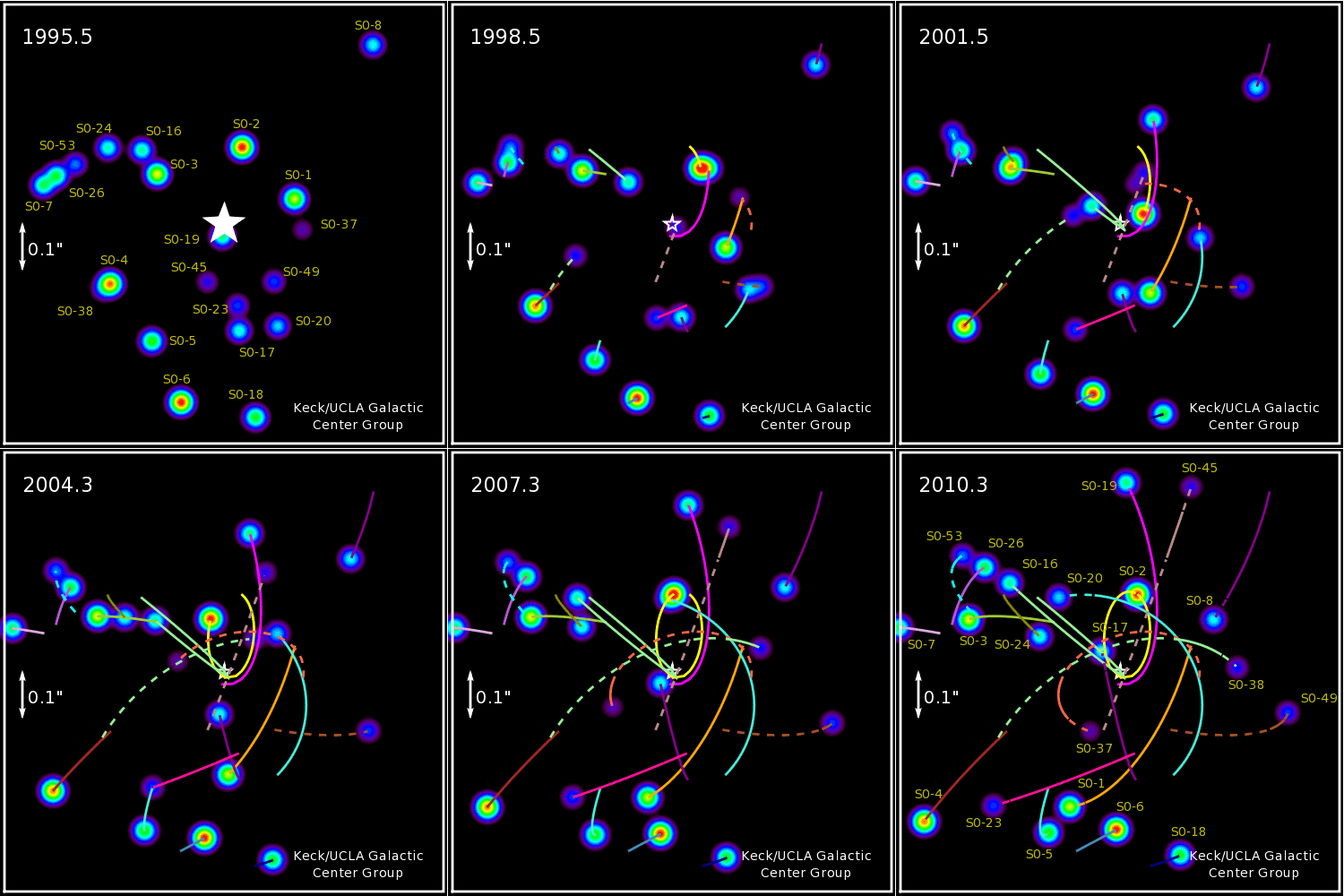
Always in motion, remember. This here nifty .gif is a simulation of actual observed star orbits in the center of our Milky Way Galaxy, and for my money, is some of the best proof of the existence of black holes.

Black holes are tricky to confirm, since they are, black, and you cannot see them. So we must infer them - above, you can see the years progressing as the stars orbit a central point of gravity. Based on the calculations of mass and speed of these stars, this gravitational point is extremely small and and extremely dense - the stars are whipping around it exceedingly fast. And this is entirely consistent with the strongly emerging theory that all galaxies are actually organized around massive black holes - stellar black holes that no doubt joined up with other stellar black holes, again and again, until they were just so massive, they drew all the remaining gas clouds and stars around them. As this matter gets drawn in, it spins, and thus we have our galaxies.

I have a working theory that black holes are even more pivotal to our entire reality than is now understood - black holes involved in the first moments of the creation of matter some milliseconds after the Big Bang. Only a theory though.

Here's some more good proof of the existence of supermassive black holes at the center of each galaxy - check out this gamma ray bulge, yo:
These bulges of highly energetic gas are streaming out of the poles of our black hole.  They're quite large too, as you can see.


Fascinating stuff, yes? That our entire universe is organized by a phenomena that is almost completely mysterious, and seems to point to extra-dimensional realities. It's good times for Cosmology.

20101116

Always deeper

I wanted to share a revelation I've had about holes: They can always go deeper. No matter how deep you think you are in the hole now, know with 100% certainty you can always go deeper. So, don't wait to get yourself out.

Also, I never realized how similar Superman's hair is with Jack Kerouac's - go ahead and look for yourself. I'm sure it was a popular hair cut back in the day, but it's strikingly  similar. I'm trying to think what a Super-Kerouac would be like. Probably something like: 'Upupup and upupup and Dean said go upupup and away to the blue American sky hanging low over the dirt farmers and assorted railroad vagrants pining time in the inky black arms of..... (it can go on like this indefinitely)." Additionally, Superman sucks. No drama, and giving up your powers for Lois Lane? Lame.


Also, too:
It's a big world, filled with all kinds of crazy folks.


Edited to add: Click here to follow all Redshirt's crazy adventures. 

20101022

The Point

I realize all this science stuff ain't everyone's cup o' tea. "Boring!" You might say. "Bring on the pics of monkeys riding in kangaroo pouches", others might proclaim. And I agree with you all! To a point. This blog, however, is big, and all encompassing. There's really no limit to my interests - pray I don't bog down in financial derivative chat!

But, my point through this last series of posts is to really lay out a vision on Perspective. You'll note that Perspective is one of the main themes of this blog. It determines everything, since we are bound in a series of systems which by default sets certain perspectives on us - our senses. For example, we are evolved to see in a small sliver of the radioactive spectrum - what we call "visible light". But that's just the way it worked out. If things had gone differently, perhaps we could also see in infrared, or ultraviolet, or in radio waves. And if that were the case, you, me, and everything we humans have built would be dramatically different. Probably no humans, for example.

So, through these last series of posts, I have gone from the smallest of the small - the quark, and the theoretical particles that might make up quarks, and the theoretical strings that might make up these particles; through protons, atoms, molecules, chemical compounds, higher and higher up the chain of existence, of complexity, to life itself; and then onto the general environment we find ourselves - citizens of Sol, our Star, re-giver of all the energy we see around us. 

Then we moved on past our star to the galaxy of stars we live in, and the wonders/terrors present in neutron stars and black holes, and finally onto the idea of the Multiverse, or even a Multiverse of Multiverses, scales of existence beyond our ken, and our Barbie.

And through it all, I keep highlighting the idea of "phase changes", for the simple reason that there is no binary, no on/off switch for anything, but rather, everything exists in a continuing spectrum of existence, crossing dimensions, spacetime, cellular boundaries, you name it. Remember: E=MC2, and thus there is no dividing line between energy and matter, but simply phase transitions between different states of existence - like ice turning to water, turning to steam, turning back to water, turning back to ice, and so on. No energy is ever lost, nor created - just transformed.

This is the reality we find ourselves, trapped really. Except we have one thing that nothing else on Earth has: Minds that can reach outside our bodies, outside our senses, and transport ourselves to completely different realities. Einstein was daydreaming on a bus when he came up with his first major breakthrough, and all of his major breakthroughs happened quite quickly in the "miracle year" of 1905.  In that one year, Einstein re-wrote our entire Universe, and moved us from creatures largely determined by our senses, to creatures that now can look past our noses and perceive the true wonders of existence - like the Multiverse, for example. Yes, Einstein built on all the work from his predecessors, and he would not have been able to accomplish what he did without them, but his revelations were truly revolutionary. He in fact took us to another level of reality - a reality beyond our senses.


And that's where we are today, cautiously wading out into an unknown ocean that often seems counterintuitive - for example, time moves at different rates depending on your speed. Weird, huh? And now that we've entered this new reality, the revelations are unfolding with greater and greater speed - it's been said, for instance, that the past 20 years have been the golden age of astronomy, such as with the discovery of exoplanets, black holes, infant galaxies, etc. 


And it continues. For example, a current theory posits that everything you know, our very Universe and everything within it, is a hologram from a higher dimension. It could be true! And perhaps we'll find out soon enough.


Regardless, the vistas that are now revealed to us are so breathtaking, so enormously vast and mind boggling, that I approach it all with the sense of the mystic: These great mysteries can be understood, but it requires one to give one's self over to the idea that everything you think you know is not the full story. In fact, it's just the surface, and beneath that surface, wonders await. Wonders that make the miracles of the Bible seem as card tricks. It's your job to dig, and keep digging, always.


And this is where I am driving all of this: The merging of science and wonder, of knowledge and faith. Faith IS important, it's just almost always misused, corrupted, or otherwise an excuse to refute knowledge. But faith and knowledge are not incompatible. I approach the Universe with Faith, since for sure, I'll never understand more than an iota of it; but! I have faith there is a System, and that system CAN be understood. Eventually....


I also am inspired by how often scientific revelations accord with Buddhist philosophy. When I first heard the phrase "Form is emptiness, emptiness form", I took it from the nihilistic perspective - nothing matters, man!


But now I see precisely what it means: We are - Literally! - empty. Atoms are 98% emptiness. We never touch anything, ever (what we think of as touch, as solid, is really the electromagnetic fields of the atoms which compose us). The galaxy is vastly empty, yet filled with everything. But underneath everything is something else, and underneath that is something else, and so on - all the way down, all the way up. Again, nothing you know in this world is as it seems - it is in fact far more miraculous than anything we could ever dream of.


And yet, still, we suffer with our petty hates and biases, bogged down by our various ignorances, ignoring the miracle which is our very existence. It's sad.


But there's always hope. Through Preachin' the Word, of course, no matter how difficult it can be to get the point across.


And finally, I find all this stuff sexy as hell. These fine ladies no doubt agree:


Peace out, y'all. 

Coda (and so much more)

As always, click for big. This nifty illustration shows my current favorite theory of the Multiverse - to wit: Our Universe (containing hundreds of billions of galaxies, each of them containing hundreds of billions of stars) is but one of many Universes - billions of them, perhaps. Perhaps an infinite amount. As you see above, this theory posits that black holes are actually conduits which feed energy into another Universe - everytime a black hole is created in our Universe, in other words, this is in fact the birth of a new Universe, in a new dimension. Our Universe was in turn created by a black hole in another Universe. And this would go on and on and on.... forever.

Here's another view:
As you see here, in this view, there are multiple Multiverses branching out - such that there might be an infinite amount of Multiverses out there, each one representing an entirely separate dimension of spacetime, each perhaps with their own, unique physics. Here's another view of the same theory:
Same idea - each link from one "bubble" universe is a black hole which created the new Universe. Again, there's no end to the number of these "bubbles". Perhaps it looks like this:
Think of it - the scale of it all. This might be the higher dimension we exist in, with our entire Universe but one small bubble amongst an infinite and ever growing dimension of bubbles, each a Universe in its own right.


That's one theory of the Multiverse, in a nutshell - Black Holes in all of them create new bubble Universes, which in turn develop Black Holes that thusly create yet another new Universe, and so on till the depths of infinity. There is another, similar, theory, however, called "Membrane Theory", or "M Theory". Here's a pictorial representation of the theory:
In this theory, rather than Black Holes being the source of creation, it is the impact between two (or more) membranes, floating in a higher dimensional space. Essentially, the Big Bang was the moment of impact, and everything since has been the energy of that impact spreading (expanding) throughout the brane. One could imagine, again, an infinite amount of these membranes, floating along gracefully in a space we literally cannot comprehend, each of them home to their own Universes, or many Universes (perhaps there's multiple impacts on each brane, and each of the impacts is its own Universe).


So, not only do we exist in a Universe of hundreds of billions of galaxies - each of which is beyond our mental comprehension - but our Universe might be one of a billion billion billion other universes, all going about their business. It's a sweeping vision of existence.


That said, I don't see how these theories could be proven - how would you test for the existence of an independent Universe in its own dimension? I can't even guess. But, that's what scientific progress is all about. I'm sure no one could have even conceived of fusion in 1630. Perhaps there's some young genius out there right now, dreaming up some crazy way we could measure the presence of another Universe.


Until then, be sure to enjoy this one.


20101021

The End (The Beginning)

And we've reached the end of the line - the Black Hole. This is an artistic rendering of what they might look like. It's doubtful anyone will know for sure for a long, long time, since they don't emit radiation of the type that allows us to see, and in fact, suck it in (the whole "Not even light can escape a Black Hole"). Perhaps you've wondered how this could be? I'm glad you asked!


Black Holes are a rather clear example of what I was talking about a few days ago, regarding "things" as opposed to "ongoing processes". There is nothing which actually makes up a Black Hole. Rather, everything we call a "Black Hole" is merely the result of a massive (and I mean massive) gravitational event which effects all of the space-time around it - we call these effects a "Black Hole". Semantic distinction, perhaps, but what isn't semantics?


So, a Black Hole is really an extreme gravitational event. I find myself amazed all the time to know that no one really understands what gravity is. You might think that's the most knowable force in the universe, since we experience it all the time - drop a rock on your toe, there's gravity. Thus, we understand the dynamics of gravity really well - this allows us to fly planes, blast off rockets, etc. However, no one knows what causes gravity, or what it actually is.


There are three main theories of gravity that have gained general currency over the past 300 years: 1. Most well known is Newton's Laws of Gravity. It's quite accurate on a day to day perspective, and in fact we got to the Moon using Newton's theory. Roughly, Newton posited an attractive force that binds matter together - he had no idea what that force is though. However, it's been shown 100% conclusively that it's not entirely accurate - for instance, our GPS system would not work using Newton's theories. Which leads us to, 2. Einstein's Theory of General Relativity. This is essentially the working theory everyone uses now. And while it has been proven in many, very conclusive ways (the GPS system again; the orbit of Mercury was accurately predicted with it; the bending of light by stars was predicted by it), no one seems very confident it's the final answer, since, when it comes to Black Holes (the most extreme gravity), it doesn't work either (it results in an infinite gravitational field within zero space [THE SINGULARITY] - both results are absurd according to current theories). We'll no doubt be sticking with Einstein's theory for a while, because it is very, very accurate. For instance, this theory introduced the concept of Spacetime - a single entity of the spatial dimensions and time. (The 3rd theory is Quantum Gravity, with an actual particle that transmits the gravity force - the graviton. No proof however of this particle, yet).


Gravity in the Einstein perspective is NOT a force. This should be stressed, as it's quite radical. All it is in the geography of space time. To wit: things with mass bend spacetime, and this bending is gravity. Objects with more mass bend it more. We are bending spacetime right now by our very existence, and when move, we create ripples in space time. Objects with the greatest mass bend spacetime to the extreme, as shown here:
As you see, Black Holes appear to rip right through spacetime, and thus our nonsensical, absurd conclusion that it has infinite gravity in zero space. Makes no sense, but this is one of the greatest mysteries in history. I suspect if we ever do find out what's going on in the Singularity, we will have opened the door to an entirely new level of science.


Black Holes vary greatly in size. When big stars explode, they create stellar black holes, and there are no doubt billions of these in the Universe. But black holes can merge with each other, and this merging process was probably quite active in the early universe, when the first stars were being born than quickly dying. They can get so big, in fact, that entire galaxies form around them - it's now believed all major galaxies formed around a "supermassive" black hole.


Black holes also go by different names  - but this is only because until recently, we did not know these different things were the same phenomena. For instance, a supermassive black hole can also be known as a Quasar. Here's a pic:


That's an entire galaxy in the center, with two giant jets of gas shooting out of the poles of the active black hole at the center of this galaxy. Such that quasars = active black holes. They're feeding, in other words.

The black hole in the center of the Milky Way was active a long time ago, but no longer. What happens is after all the chaos of creation, things settle down, and eventually all the matter surrounding the black hole stabilizes in orbits far enough away that it doesn't get sucked in. Once this happens for long enough, the black hole goes quiet, and simply spins in the middle of the galaxy, creating the momentum for the entire galaxy's rotation.

It's even possible there are micro black holes everywhere - right in front of your nose, for example. But little proof has been offered for their existence or creation.

I leave with you the most common type of black hole: the Binary star system, unbalanced. In the upper right is a real picture of what we assume is a black hole.


Bet you didn't know that the vast majority of stars in the universe are in pairs: Binary systems. Our single star is the exception to the rule. Most of these pairs are lopsided, however, with one bigger than the other. The bigger one exhausts its fuel faster, and thus enters the death spiral faster, and if it's big enough, it will create a neutron star or black hole. Which is the kiss of death for it's surviving sibling. I'm sure as it's getting sucked into nothingness, it's thinking "NOT FAIR!"

But what is "fairness" in this vastness?

20101020

The next link in the chain

Our sun, again. It's pretty big, eh? But not really - in the grand scheme of it all, our star is pretty average in most respects, which is a good thing. Because stars get a lot, lot bigger. For example:
 And that's big. Stars of this size burn hot and fast, living only a fraction as long as our star. Stars of this size play by some different rules. For example, their fusion process is different:
 Big stars were far more common in the early universe, and it is the big stars which made ALL elements in existence heavier than Iron (and a great deal of the iron too). For, you see, Stars are alive in the sense they are born, live (by burning - a hallmark of all life), and then die. Here:
 Fret not - our star is not going Supernova. Rather, it will puff up, eat all the planets out to Earth, and then shrink way, way down to a White Dwarf, and remain like that for billions and billions of years. The big stars, however, cross a threshold - a phase change, if you will, going up the chain (of temperature/pressure). As you can see, based on the size of the star, when these big guys go, they end up as a Neutron Star, or a Black Hole. More on Black Holes in the next post. 
  A neutron star is an exceedingly strange thing. First, they only come about when massive stars explode, and the remaining core shrinks down to the size of Manhattan. However, this small space contains an ENORMOUS amount of matter, so dense that a teaspoon of it would weigh more than the entire Earth. A neutron star has a solid crust, of Iron - how strange is that? It experiences "starquakes" on its surface, just like earthquakes, but on a scale beyond comprehension. But I am most interested in the interior, for, from what I can gather, the center of a neutron star sits on a line of reality - on one side is our universe, filled with energy, matter, stars, planets, etc; on the other side, is the Singularity of a Black Hole, which no one really has any idea about.
Neutron stars can go by a couple of different names. They're also known as Pulsars, due to the two jets of matter spewing out from the poles. They're also known as Magnetars, due to the incredible magnetic fields generated by this much mass/energy contained in such a small space, spinning incredibly fast. Again, the neutron star resides on the line between our reality of gravity, and the gravity of a black hole (which is "infinite"). 

My point? This line, of creation/destruction, reality/some other reality. There is so much mystery here it boggles my mind. Think of the processes involved: There was the Big Bang (another huge mystery) which produced the raw materials for everything; this material cooled over time, forming matter through phase changes; this matter aggregated, and eventually formed the first atoms (hydrogen and helium); these atoms coalesced into humongous clouds that blanketed the entire universe in darkness until, due to the vagaries of time/space, one very, very special cloud got very dense, and more matter was drawn to the center, making it denser, and so on; it began to spin, and draw in more matter, until BOOM! The birth of the first star, powered by an engine of creation hitherto unknown in existence: Fusion. Then another star was born, and another, and a million billions others. All huge, gigantic stars that burned hot and fast, and then exploded, seeding the early universe with all the elements we know today, and providing the material for the next generation of stars (ours is 3rd generation, I believe).

But they also left behind Neutron stars and Black Holes. Which might appear to be destruction incarnate, but really became the gravitational loci of the newly forming galaxies - our ultimate homes.

So, once again, over and over and over again - creation = destruction. All opposites are the same. Binaries are illusions. Yadda Yadda. In other words: We live in a constantly unfolding miracle that we barely perceive or understand. I find it inspiring, since there's so much more we can know. About the universe, and thus about ourselves (we are made, LITERALLY, from the material ejected by a Supernova).

And oh yeah, here's an actual Neutron star, viewed in X-ray:

20100608

Expanding

Expansion from a Singularity - that's the headline which describes our entire reality. As you can see, everything is getting further away from everything else as time goes along, since space time itself is expanding (like an inflating balloon).

This picture is a version of the cone diagram showing the WMAP survey two posts down. There is a big debate in science as to the future of this expansion - will it continue? Speed up? Slow down? The answer determines the future of our Universe. If it were to speed up, then eventually (some 20-30 billion years from now), matter itself will start to fall apart as the expansion of space time pulls apart the nucleus. 

If it slows down, then we could be heading for a Big Crunch, in which gravity gains the upper hand and pulls everything back down into a Universal size Singularity (which, in my preferred theory, would then eventually explode again, forming a new Universe).

No one is sure right now how it will play out. Regardless, we'll never see it. So, enjoy your day!

20100607

All signs point to the Singularity

Here's some examples of how matter bends spacetime - think of it like a bowling ball laying on a sheet, bending it down based on its weight (except in reality it's not a flat plane, but rather a sphere). Stars by themselves are large objects that massively bend spacetime, but compared to their remnants - neutron stars and black holes - they're tiny.

I'm focusing on Black Holes here, and specifically the Singularity which lies at the heart of every black hole (it is the object, in fact; everything else is a by-product of the Singularity). But Neutron Stars are extremely interesting in that they still reside in our "normal" world of physics we understand, yet they are right on the line to becoming a black hole, and are very strange. Did you know the surface of a neutron star is solid, and a neutron star could in fact be considered a single, solid particle?

Anyways, the Singularity - the point at the center of the black hole. It's called a Singularity simply because there's no other good words to describe it - we literally have no idea what happens in a Singularity, whether the rules of physics apply or not, etc. As our current understanding works, the Singularity is defined as infinite gravity in zero space; which is impossible, and thus the big task in physics today is to understand the Singularity.

Here's two diagrams showing the composition of black holes:
Again, these are not real structures per se, but rather the results of the Singularity in action. Black Holes are black because anything that reaches the event horizon never comes out, including light. No light means we can't see it - even using x-rays, gamma rays, etc. However, the areas just outside the event horizon can be seen, and in fact, at the north and south pole of every black hole will be large jets of gas shooting out, detailed here:
To wit: We know we don't know anything about the Singularity, and all we do know comes from its interaction with the surrounding Universe. We also know that there is a Singularity with every black hole (by definition), and we know that our Universe could be filled to the brim with black holes. There are different categories of black holes: stellar (made from an exploding star), and supermassive (likely the result of many mergers between stellar black holes). As an example of how fundamental black holes are to our existence - every galaxy (including ours) has a supermassive black hole at its center, such that, to me, it seems a supermassive black hole is a requirement for galaxy formation.

So, to bring it all home: We don't know anything about Singularities, and this lack of knowledge makes it likely our current models of physics are not correct, or at least missing something big (couple that with the matter distribution chart below - would you trust a theory that said "I don't know anything about 96% of the Universe"?) . We do know that Singularities are numerous, however, and important to the way our Universe works.

And finally, as I've shown with models of the Big Bang, scientists refer to the moment before the conception of Universe as a Singularity as well, since we don't/can't know anything about it. If correct, our Universe, and everything in it, came from a Singularity - the same type of object that exists right now throughout our Universe in Black Holes.

And now my theory - MY theory, so feel free to correct: The Big Bang was the result of a Singularity in another Universe exploding, and this explosion created a new Universe - ours. This process happens all the time, and eventually, once a black hole(S) get big enough, will happen in our Universe as well. This is the foundation of the Multi-Verse - a higher order dimension that contains Universes like so many soap bubbles. Think of the scale of that for a while.

Once again, we come from nothing, which is also everything. Form is emptiness, emptiness form.

20100227

Always Falling

Gravity could be described as "the perpetual state of falling". As you see above, the Relativistic concept of Space-Time is an actual medium which is bent by mass, causing distortions in space. These distortions are what we call gravity - Jupiter creates a much, much larger indentation in space than Earth, and thus has much, much higher gravity.

The Sun is well off the chart here, but the sun too orbits something - and to orbit something is simply to be falling towards it. Our sun orbits the supermassive black hole in the galactic center of the good old Milky Way; our supermassive black hole and thus our galaxy orbits around a central gravitational spot we share with the Andromeda galaxy, or in fact the supermassive black hole at the center of Andromeda; together, along with dozens of small galaxies, we all orbit a far, far larger central gravitational spot along with clusters of other galaxies; and so on and such until we are talking about vast mists, spider webs of millions and billions of galaxies swept along the ever expanding bubble which is our reality.

And everything that is not in the center of that bubble - which is everything - is falling, always falling. And spinning.

20100226

Defined by Nothing (and Everything)

This is a brand spanking new simulation of how scientists think quasar jets behave. First, some definitions: It's now believed that quasars, blazars, and radio galaxies are all actually the same phenomena: Jets of matter streaming away from the active black hole at the center of the galaxy (as pictured above). We give this phenomena different names due to where in relation we are to this jet - head on, and it's a blazar; at an angle, it's a quasar; at 90 degrees, it's a radio galaxy. A nice analogy is the old saw about blind men describing an elephant - each will have a different description for the same thing.

Anyways, black holes are no longer thought of as simple engines of destruction - as shown above, not only do they spit out a great deal of matter, but they are active agents in the creation of not only stars, but galaxies of stars. Come back with me, to the beginning of time.....

It's a little bit after the Big Bang. Shit is hot, and dense, but uniformly blah. Stuff keeps spreading out and cooling down bit by bit, until the first atoms form (hydrogen and helium). Cooling and spreading continues, and now we have incredibly large clouds of hydrogen and helium, which begin to form denser pockets. These dense pockets continue to get denser as gravity draws matter to matter, until POOF! A star is born (consider: There was a 1st star), and another, and another, and so on. But these early stars lived fast and hot, and died young. Not long after they started forming, we enter the era of the Supernova, which must have been extreme. All these young stars exploded, creating all kinds of new elements in the process, but also, and most critically, creating the first black holes.

This is still not long after the moment of creation. Black holes start doing their thing - sucking down matter and energy. In so doing, many, many, many more stars are created, and some of these explode, forming more black holes, which merge with other black holes, and so on and so on until we have a supermassive black hole, and with this, we have our first Galaxy, which is really nothing but a collection of stars in orbit around a central black hole.


So, in conclusion for now, everything about our reality was formed in large part during this era of black hole creation. We owe our existence to this phenomena of apparent absolute destruction, which has "nothing" lurking at its core.

Form is emptiness, emptiness is form. Also, more spirals.

20100127

Black Hole Suns


This here image represents stars orbiting a supposed black hole - the only way, practically, to find black holes: by their effect on the matter around them.

The supposed black hole is the star icon in the center, and each different colored dot represents an actual measurement of a specific star's orbit, and the rest of the orbit is calculated therefrom.

Briefly as I can, black holes are the remnants of massive stars that go supernova. If the star is really big, but not quite big enough, it becomes a neutron star: essentially, a single nucleus the size of Manhattan, made of an incredibly dense fluid. And so on down the line, the smaller the star, the less dramatic will be the aftermath. Our star, for example, will puff up big for a while, but then simply shrink down and wink out, eventually, with no big explosion.

Anyways, a black hole could also be called a Singularity, a word used to describe what is frankly impossible in physics: Infinite mass in zero space. How could that be? The effect of the black hole on space-time (think of space time as a giant loaf of slowly expanding bread - every thing that has mass presses down onto this bread, depressing it to the degree of their mass.) is to essentially rip it - a depression in space time so deep we really don't know what is at the bottom, except for infinite gravity in zero space....

But! There is a thing down that hole which could be called the physical manifestation of the black hole: Matter, space-time itself falls down into the hole, faster than light, generating enormous, enormous, enormous energy (and heat). The further down you go the faster you fall, except you're also being compressed. As the compression and speed increase ever further down, eventually you reach a spot where there's just nothing more to do, and matter is actually forced back up the black hole, ever so briefly. There it meets the matter falling down, of course, creating an interference which we would describe as a cloud. A black cloud of inconcievably hot matter.


Finally, it is always interesting to me to consider that, supposedly, our Universe, our entire reality, was "big banged" out of a Singularity. And now, consider the notion of thousands of Singularities, tens of thousands, existing in every galaxy. Is it the same Singularity? The same kind or type? Something entirely different?

No one knows - but mark my words well: This notion of the Singularity, if we can ever tease meaning out of it, will be revolutionary.

20091231

All things are scaled


By scaled, for example, imagine this picture represents the gravity wells of Blackholes, where the clouds represent our space/time, and the funnels represent gravity wells caused by the Blackhole.

At this point in time, we know the following about Blackholes:

- Giant versions of them exist at the center of every galaxy.

- At the center point of a blackhole, our physics breaks down and we understand nothing. This is the definition of a Singularity, just like the one that birthed our Universe. I don't think that's a co-incidence.

- They exist in microscopic form, coming into and swiftly exiting out of existence all around us.

- No one really knows what a blackhole is, other than a phenomena we observe defined by gravity in the extreme - extreme into the Singularity, where gravity is so dense there is no more matter, no more energy. Where it goes, what happens, no one knows.

Everyone's betting multiple dimensions, however. So, consider.

20080729

Oops, I forgot this method of apocalypse

This happy looking fellow is the CERN Large Hadron Collider*, and it will soon conduct its first large scale test.

The LHC has a circumference of 17 miles, and is buried on average some 150 feet underground.

The purpose of the LHC is, according to the Wiki, to find out the following:

All sounds great. But, there is the matter of "micro black holes, strangelets, vacuum bubbles and magnetic monopoles", and I can tell you from experience, all it takes is a few micro black holes and strangelets to ruin your day.


But I kid! I'm sure this science project won't destroy the earth and/or the solar system.

Fun related facts: Did you know that the scientists testing the first nuclear bombs could not be sure if the nuclear reaction they would cause would cascade into a chain-reaction, destroying all matter?

Glad that didn't turn out to be true...


*also known in other circles as the Large Hardon Collider