Did you hear the big nerd news? Disney bought LucasFilms, and so now the Mouse owns The Force. I don't like it in principle cuz "Monopoly" but creatively, hell yeah! Lucas was space drunk on his own fame/wealth and turned to crap. But he only got 4 billion for it, which, combined with the many other billions he's made off Star Wars, heh. You win, George, you win. Here's a cosmic Ring:
A spiral of death, a sun-like star expelling outer shells in its old age, prelude to star's end. Fitting for the finger of such a creative titan. But here's an industry secret: False Color
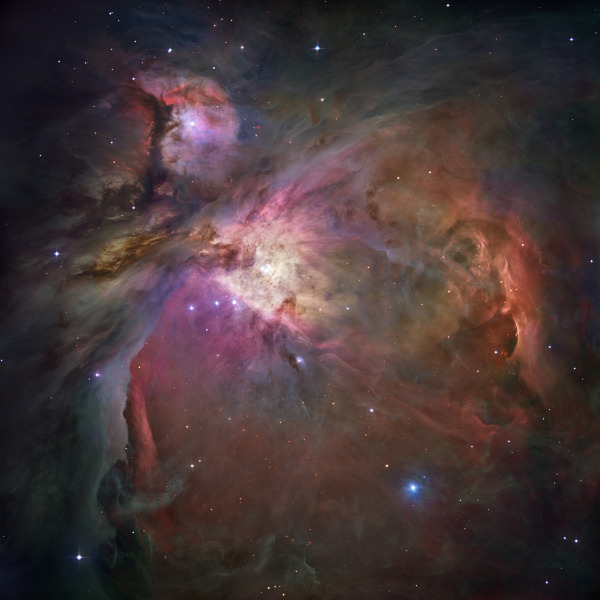
Mighty Orion, most beautiful of all nebula. But this picture, and pretty much every awesome astronomy picture you've seen, is a 'shop of sorts. In some form or another, astronomers take the raw data of their images and "translate" these images into colors. Since data is just numbers, in this case, the redshifts of various elements. These redshifts are numbers, these numbers are translated to colors, the colors you see above. What you might see with your eye could be quite different. Who knows - you'll never get a chance.
But isn't "False Color" what our brain is doing with all color anyway? Without eyes to see, there's no blue, or red, or green. Just frequencies of radiation. It is the seer that defines color, and thus, all of life is "False Color".
Or at least creatively enhanced.
Showing posts with label orion. Show all posts
20121223
20110315
Proto too
This is an artist's representation of a protoplanetary disk, or, that is, a new solar system coming into existence. All stars form from large clouds of space dust that for one reason or another begins to compress, and with this compression comes a spinning. This builds and builds and the center of the swirling cloud grows hotter and hotter until BAM! Hot enough for fusion, and, literally, a star is born. In various parts of this spinning disk there are areas that are denser than others. These areas go through a similar process of compression and spinning, but never get hot enough to form a star - rather, they become the seeds of planets. Over time, and chance, some grow big enough to start sucking in all sorts of other rocks and gas and dust and they swell in size. It's a crap shoot, but inevitably, planets will form around the new star. This is how our Sun and Earth and everything else in our Solar System came into being. And it's happening all the time, all over space. Look!
These are actual photos of two new stars - you can see the star and disk in the center, with lots of remaining gas strewn about. This far off gas will no doubt form, in time, something similar to our Oort Cloud. Here's a cool closeup of a new disk in the Orion Nebula:
We're looking at a new Solar System, edge on. Amazing - think of the perspective here, size wise. Here's another shot from Orion, showing multiple disks all in a row:
And here's a group shot of a bunch of disks from Orion:
Like a stellar yearbook. Each of these is a massive star, as big or bigger than our own, and each is busily forming planets, like our star, like every star. This is what happens out there, man!
What's cool to consider is our star of course formed in precisely the same way, some 4.6 Billion years ago. We, too, were part of a large nebula, and had many, many Sister stars being created right alongside. Where they are now, no one knows for sure, since, over time and the frequent creation of stars, the nebula will eventually dissipate, and each star will wander off to make its own way in this big, big Galaxy.
To witness this process happening live, in Orion, is Godlike, in my opinion - we are gazing down from on high at the very creation of planets and stars, and all the things that come with that. This is the rush I get when pondering this subject - how incredibly powerful our science has made us, and yet, we've just scratched the surface. There's no end to the wonders out there.
I leave you with a huge picture of the Orion Nebula - the BEST Nebula. Grab some binoculars and check it out yourself - second "star" in the Constellation's sword.
Click for big, and look to the slight lower left of center - you can see a protoplanetary disk kicking up turbulence in the far larger cloud. It's beautiful, yeah?
These are actual photos of two new stars - you can see the star and disk in the center, with lots of remaining gas strewn about. This far off gas will no doubt form, in time, something similar to our Oort Cloud. Here's a cool closeup of a new disk in the Orion Nebula:
We're looking at a new Solar System, edge on. Amazing - think of the perspective here, size wise. Here's another shot from Orion, showing multiple disks all in a row:
And here's a group shot of a bunch of disks from Orion:
Like a stellar yearbook. Each of these is a massive star, as big or bigger than our own, and each is busily forming planets, like our star, like every star. This is what happens out there, man!
What's cool to consider is our star of course formed in precisely the same way, some 4.6 Billion years ago. We, too, were part of a large nebula, and had many, many Sister stars being created right alongside. Where they are now, no one knows for sure, since, over time and the frequent creation of stars, the nebula will eventually dissipate, and each star will wander off to make its own way in this big, big Galaxy.
To witness this process happening live, in Orion, is Godlike, in my opinion - we are gazing down from on high at the very creation of planets and stars, and all the things that come with that. This is the rush I get when pondering this subject - how incredibly powerful our science has made us, and yet, we've just scratched the surface. There's no end to the wonders out there.
I leave you with a huge picture of the Orion Nebula - the BEST Nebula. Grab some binoculars and check it out yourself - second "star" in the Constellation's sword.
Click for big, and look to the slight lower left of center - you can see a protoplanetary disk kicking up turbulence in the far larger cloud. It's beautiful, yeah?
Subscribe to:
Posts (Atom)