

Showing posts with label Physics Phun. Show all posts
Showing posts with label Physics Phun. Show all posts
20150313


20120512
Gondolin Water Works


Anywho, the bog is gone, and the stream is now some 400 feet long, all dug out and waiting to be prettified. The amount of water channeled through this system is incredible, and even more so, I've got projects here in Gondolin to last a lifetime. I envy myself.
As a goodbye, here's an artistic blurry photo of a deciduous bloom, in honor of all its fallen sisters:

20120320
#Occupy Jupiter

And this is the chain of our existence. Dig it: From quarks and electrons, joining to form atoms, atoms joining to form molecules, molecules joining to form complex bonds, and based on their composition, we have our world and everything in it - rock, water, air, tree, you, me, even your pee. Complex groupings of molecular bonds.
Now, above you and me is space, vast and full of everything. Great, gigantic clouds of hydrogen light years long start to spin, perhaps disturbed by a nearby nova, and in the spinning the denser material falls towards the center of the spiral in ever increasing mass, causing ever greater heat, so on and such until there is a new joining, a new bond: Fusion. And fusion produces pretty much all of the energy you see around you. That makes you up. Energy and matter is our reality.
But fusion is not the end, for when the supernova collapses it can go one of two ways: A neutron star - a tripped out ball of neutrons (no atoms) spinning so fast yet so regularly they can be used as interstellar clocks. No bigger than Manhattan, they are denser than our entire solar system.

OR, a Black Hole.

Which is the ultimate break with this reality of ours - for everything goes in, the BH can get bigger or smaller, quieter or more active, like a "thing", but all of the energy and matter that falls in to it appears gone, into nothingness - for there is no such thing as a Black Hole, just its effects on gravity. The so called "Singularity" at the center of a Black Hole is just a placeholder word, since no one has any real idea. Our physics says it is of zero space yet infinite mass, which is absurd. You can't measure it directly, since it is literally a hole - everything falls through. And so either our mathematical theories are wrong, or we just don't have a clue. Yet. Science will find a way, eventually.
So, from electron to Black Hole and everything in between - this is our reality from start to end and swirls so large and endless around us, be of good cheer, for you are here, in this amazing grace, able to appreciate it. From time to time. Ramen.
20110114
Beneath You


And thus a true scientist is humble, and operates with a wondrous mind straddling two worlds: Current, operational facts that have proven successful to date, but always open to the idea of new facts, new ways of being, that are truer, better, more close to the real than before. And one needs to adapt at any time to these new facts. Some people can't do this, it seems. Some can.
Which are you?
Also too, for scale purposes:

Or, as Granny said:

20110113
Stop: Corroborate and listen
Here's some evidence to many of the points I made below, from real life Science types. From highest/biggest to lowest/smallest:
 Simple drawing show one concept of the multiverse - and remember: The part we can see might just be a smaller part of a bigger Universe, but even that larger Universe is just one bubble in an ocean of bubbles, which in turn might just be one bubble in an even bigger multiverse, and so on, forever. However, this is purely theoretical, since, how can you test for it?
 Our bubble (artist's representation). Looks like a cell, right? The white lines would be matter/energy, and the blue would be the expanding sphere of spacetime.

A close up into the pic above - partly artist representation, partly real photographs. Consider in the above as we zoom in closer and closer, you finally see a galaxy. Thus, what you're looking at here are strings and strings of billions of galaxies - they make a structure unto themselves, a structure we are part of. Here's some real proof:
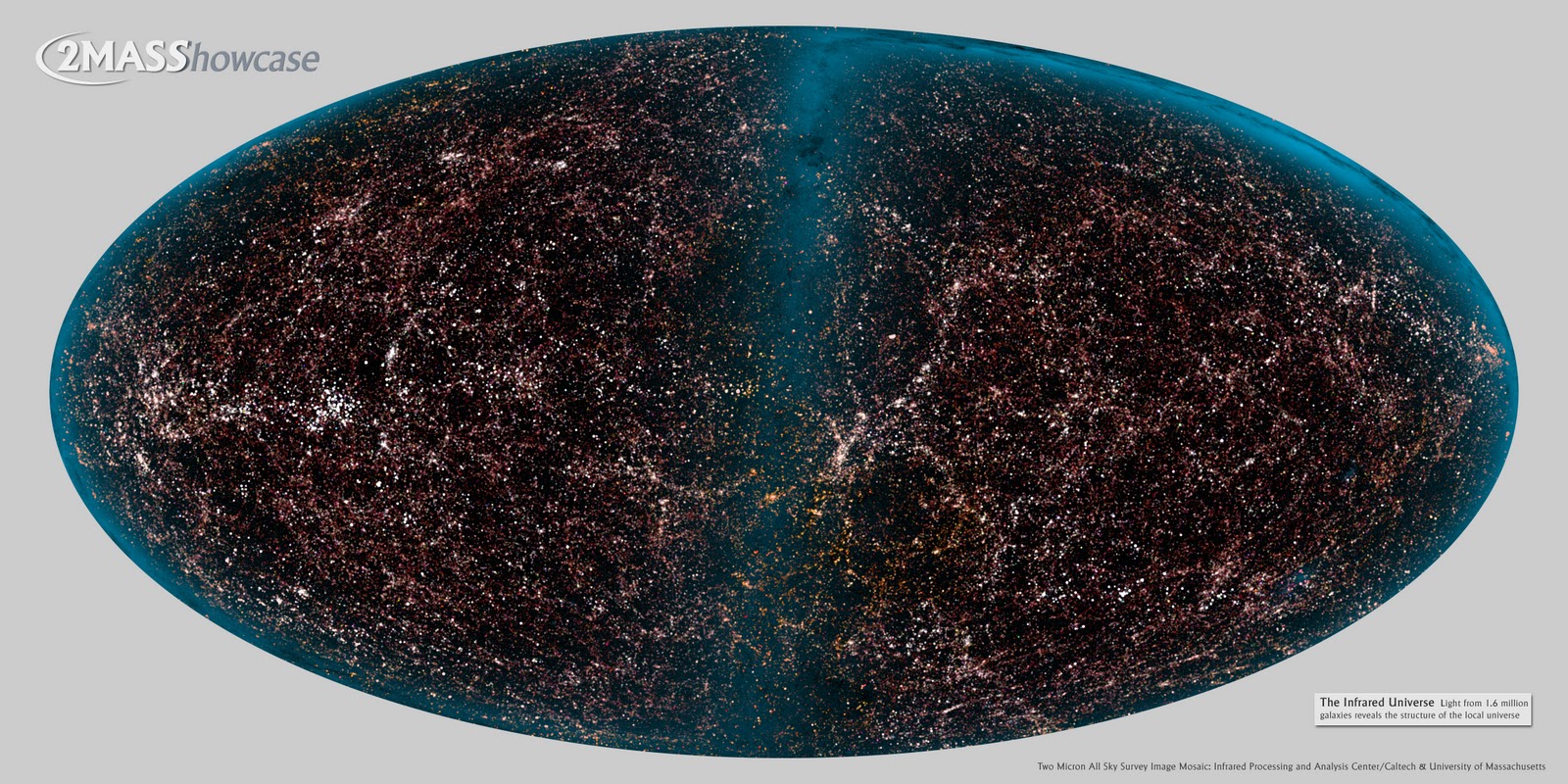
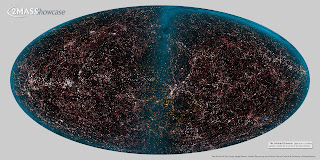 Click for big - an actual photo of 1.6 million galaxies, which in the scheme of things is a drop in the bucket. But you can see the filament like structure they're arranged in. Now, each and everyone of these point of light is really this:
 A galaxy. This is M31 - Andromeda - our nearest big galactic neighbor. Bigger than us in fact. But just one galaxy among the countless billions and billions, all filled with:
 Stars and planets. This is an actual photo of a star with three exoplanets orbiting around. There's probably many more, and at this point, everyone's coming to the tentative conclusion that almost every star has planets, and even other weirder things like neutron stars have planets. There's planets everywhere.
That covers section 2 below, in which I tried and show the Universal gravity well which defines our reality - going back up from the planet to the star to the galaxy to the collection of galaxies and so on is to go ever deeper down into that gravity well. Whilst simultaneously....
 Our entire Universe - our bubble - is expanding. Above shows 4 possible outcomes of this expansion, and the answer is dependent on the speed of the expansion versus the pull of gravity. In each of these examples you can see the entire universe displayed, but make no mistake - it's always there, expanding. Option1 (Big Crunch) makes a lot of intuitive sense, but the data is pointing to option 4 instead, which would leave us - trillions of years in the future - in a universe of no energy or matter. Nothingness.
And finally, imbalance:
 Here's the famous pic from the WMAP satellite showing temperature variations in our very early universe. The other examples show how this variation plays out on smaller scales. Now, important to note - the actual variance from one spot to another was incredibly, incredibly minuscule. But it's enough to measure, and it was enough to produce everything you see or could ever see around you.
And us? We're a dream, I think - a fizz of energy that arises and subsides. Life - all life - fits into this model, somewhere, and I think it's entirely as a chemical process. Making us a darn smart chemical reaction, I tells ya:



A close up into the pic above - partly artist representation, partly real photographs. Consider in the above as we zoom in closer and closer, you finally see a galaxy. Thus, what you're looking at here are strings and strings of billions of galaxies - they make a structure unto themselves, a structure we are part of. Here's some real proof:


That covers section 2 below, in which I tried and show the Universal gravity well which defines our reality - going back up from the planet to the star to the galaxy to the collection of galaxies and so on is to go ever deeper down into that gravity well. Whilst simultaneously....

And finally, imbalance:

And us? We're a dream, I think - a fizz of energy that arises and subsides. Life - all life - fits into this model, somewhere, and I think it's entirely as a chemical process. Making us a darn smart chemical reaction, I tells ya:

20110112
From the diary of a madman

In the picture above, 1. represents our expanding spacetime bubble, our Universe. From a conception point of infinite density and almost zero space, no time, all was born in an "explosion", then vast inflation. This expansion continues, and on the largest of scales, all matter is spreading apart. Give or take a trillion years and our Universe will be a vast bubble of emptiness, with all matter/energy degraded to it's least energetic, least dense form. Nothingness.
Simultaneously, in 2. above, as a subset of 1. gravity creates vast spiral depressions in spacetime, and at the largest scales these depressions encompass billions and billions of galaxies, and perhaps even more. Everything falling down, always orbiting something deeper in the hole. From the Earth we live perched on the edge of a Universal whirlpool, swirling ever further down - this is the inherent reality to all spacetime we could ever exist in. And remember, that with increasing gravity is slowing time, and thus time stops somewhere in our reality. But where....
Leading to 1a., purely hypothetical, which shows that at every black hole - and they get ever bigger and bigger - a new Universe is "Big Banged" out the other side, and thus expanding and creating stars and other black holes and galaxies and thus other Universes that "Big Bang" out of these black holes, so and such forever. This, too, is our reality, our environment, what we exist in. We are part of it all.
2a. is just a more basic illustration of the gravity well we're all and everything perched within, and you can think of it exactly like a great whirlpool in the ocean, and we're all spinning along at some level of it. Except of course this whirlpool exists at all points, all times in space. It's everywhere and everything. Falling.
The middle section graphs some divergent relationships - and that's what our reality, our very existence is all about: Imbalances. We exist because of imperfections, flaws in a perfect design. Because one side is hotter than another, because one little bit of space is denser than another, because there were basic imbalances at all levels of reality as we "Big Banged" these imbalances expanded as the Universe itself expanded, and became our reality of Motion - imbalance creates motion, as hot seeks the cold, less dense seeks the dense, high frequency seeks low... everything seeks the perfection of balance, I suppose. But if we ever get there, it will be in that trillion years hence when all matter/energy is spread out, completely and evenly throughout a vastly larger Universe. Nothingness. So who needs perfection? Embrace the imperfect, as it is the very reason we're here.
And thus we reach the end of a 40 minute quickie. I don't claim to propose anything new with this, just a summation of what I've gathered is current thought on "our reality".
Which, again, is just one of many. It's mind boggling to me when I consider the truth of our existence - so ever small, and yet, here we are, talking about it. Big big.
20110111
Upside down you're turning me

Also, and I suspect I will be going on and on and on about this in the days to come, but here's a thought: Everything you see exists in the past. Everything - even if you look at your own hand. Why? Well, the only way we can see something is by light striking it (or coming from it) and then traveling to our eyes. In that travel, time passes. It's minuscule, microscopic to be sure, but real. And the effect gets more pronounced with more distance AND/OR less gravity. Gravity slows down time - weird, but true.
And thus, to conclude for now, quite literally, this guy floating around on the ISS playing with his beverages, is in THE FUTURE.... that is, his internal clock is going ever so slightly faster than ours.
Ponder that for awhile and let it sink in. It's a rather revolutionary concept.
20101208
Always in Motion

We still use many anachronisms in our daily speech - sunrise and sunset, for example. Fact is, the sun's doing nothing of the sort, but rather our planet is spinning at approximately 26000MPH. When the Earth turns towards the sun, that's "sunrise".
So the Earth is spinning, but it's also moving, round and round the sun. But the Sun is moving too, round and round the center of the galaxy. And the Milky Way is moving too, round and round a shared gravitational center with Andromeda - and our local group of galaxies are moving round and round a shared gravitational center with another group of galaxies, and so on, forever.
Everything is in motion - including, at all times, every particle that makes you up.
All this motion means, there is no "absolute motion" - what would you judge it against? And thus, we have Einstein's relativity. Easy example: You're at the train station, and a train goes flying by. On the train, a boy is tossing a ball up and down. To you, the ball looks like it is arcing through the sky; to the boy, the ball is going straight up and down. One action, two completely different frames of motion, and thus it appears different to different observers. This is a powerful concept.
But not why I'm here. Rather, redshift (Redshirt cousin). Whether you know it or not, you're familiar with the Doppler Effect - an approaching police car with siren will sound higher pitch as it approaches you (because the sound waves are more compact, higher frequency), and then lower pitched as it pulls away, even though from the police car perspective, the sound never changed.
The same happens with light - light from a source heading towards us will appear bluer - shorter, more energetic wavelengths. Light from a source moving away from us will appear redder - longer, less energetic wavelengths. Turns out, almost everything is moving away from everything else, and thus the theory of the Big Bang (if everything's moving away from everything else right now, than it follows everything used to be closer together).
But that's also not why I'm here. Rather, witness the wonders of Spectroscopy!

And thus, you see how light is "scattered" as it hits our atmosphere, and encounters the gases within it - these black lines represent a "scattering" of sorts.
Finally, because of this interplay of electromagnetic wavelengths (remember, visible light is only one small piece of the overall electromagnetic spectrum) and the elements, we have the warm and welcoming world we live in today. Look!

20101022
The Point

But, my point through this last series of posts is to really lay out a vision on Perspective. You'll note that Perspective is one of the main themes of this blog. It determines everything, since we are bound in a series of systems which by default sets certain perspectives on us - our senses. For example, we are evolved to see in a small sliver of the radioactive spectrum - what we call "visible light". But that's just the way it worked out. If things had gone differently, perhaps we could also see in infrared, or ultraviolet, or in radio waves. And if that were the case, you, me, and everything we humans have built would be dramatically different. Probably no humans, for example.
So, through these last series of posts, I have gone from the smallest of the small - the quark, and the theoretical particles that might make up quarks, and the theoretical strings that might make up these particles; through protons, atoms, molecules, chemical compounds, higher and higher up the chain of existence, of complexity, to life itself; and then onto the general environment we find ourselves - citizens of Sol, our Star, re-giver of all the energy we see around us.
Then we moved on past our star to the galaxy of stars we live in, and the wonders/terrors present in neutron stars and black holes, and finally onto the idea of the Multiverse, or even a Multiverse of Multiverses, scales of existence beyond our ken, and our Barbie.
And through it all, I keep highlighting the idea of "phase changes", for the simple reason that there is no binary, no on/off switch for anything, but rather, everything exists in a continuing spectrum of existence, crossing dimensions, spacetime, cellular boundaries, you name it. Remember: E=MC2, and thus there is no dividing line between energy and matter, but simply phase transitions between different states of existence - like ice turning to water, turning to steam, turning back to water, turning back to ice, and so on. No energy is ever lost, nor created - just transformed.
This is the reality we find ourselves, trapped really. Except we have one thing that nothing else on Earth has: Minds that can reach outside our bodies, outside our senses, and transport ourselves to completely different realities. Einstein was daydreaming on a bus when he came up with his first major breakthrough, and all of his major breakthroughs happened quite quickly in the "miracle year" of 1905. In that one year, Einstein re-wrote our entire Universe, and moved us from creatures largely determined by our senses, to creatures that now can look past our noses and perceive the true wonders of existence - like the Multiverse, for example. Yes, Einstein built on all the work from his predecessors, and he would not have been able to accomplish what he did without them, but his revelations were truly revolutionary. He in fact took us to another level of reality - a reality beyond our senses.
And that's where we are today, cautiously wading out into an unknown ocean that often seems counterintuitive - for example, time moves at different rates depending on your speed. Weird, huh? And now that we've entered this new reality, the revelations are unfolding with greater and greater speed - it's been said, for instance, that the past 20 years have been the golden age of astronomy, such as with the discovery of exoplanets, black holes, infant galaxies, etc.
And it continues. For example, a current theory posits that everything you know, our very Universe and everything within it, is a hologram from a higher dimension. It could be true! And perhaps we'll find out soon enough.
Regardless, the vistas that are now revealed to us are so breathtaking, so enormously vast and mind boggling, that I approach it all with the sense of the mystic: These great mysteries can be understood, but it requires one to give one's self over to the idea that everything you think you know is not the full story. In fact, it's just the surface, and beneath that surface, wonders await. Wonders that make the miracles of the Bible seem as card tricks. It's your job to dig, and keep digging, always.
And this is where I am driving all of this: The merging of science and wonder, of knowledge and faith. Faith IS important, it's just almost always misused, corrupted, or otherwise an excuse to refute knowledge. But faith and knowledge are not incompatible. I approach the Universe with Faith, since for sure, I'll never understand more than an iota of it; but! I have faith there is a System, and that system CAN be understood. Eventually....
I also am inspired by how often scientific revelations accord with Buddhist philosophy. When I first heard the phrase "Form is emptiness, emptiness form", I took it from the nihilistic perspective - nothing matters, man!
But now I see precisely what it means: We are - Literally! - empty. Atoms are 98% emptiness. We never touch anything, ever (what we think of as touch, as solid, is really the electromagnetic fields of the atoms which compose us). The galaxy is vastly empty, yet filled with everything. But underneath everything is something else, and underneath that is something else, and so on - all the way down, all the way up. Again, nothing you know in this world is as it seems - it is in fact far more miraculous than anything we could ever dream of.
And yet, still, we suffer with our petty hates and biases, bogged down by our various ignorances, ignoring the miracle which is our very existence. It's sad.
But there's always hope. Through Preachin' the Word, of course, no matter how difficult it can be to get the point across.
And finally, I find all this stuff sexy as hell. These fine ladies no doubt agree:

Peace out, y'all.
20101020
The next link in the chain


My point? This line, of creation/destruction, reality/some other reality. There is so much mystery here it boggles my mind. Think of the processes involved: There was the Big Bang (another huge mystery) which produced the raw materials for everything; this material cooled over time, forming matter through phase changes; this matter aggregated, and eventually formed the first atoms (hydrogen and helium); these atoms coalesced into humongous clouds that blanketed the entire universe in darkness until, due to the vagaries of time/space, one very, very special cloud got very dense, and more matter was drawn to the center, making it denser, and so on; it began to spin, and draw in more matter, until BOOM! The birth of the first star, powered by an engine of creation hitherto unknown in existence: Fusion. Then another star was born, and another, and a million billions others. All huge, gigantic stars that burned hot and fast, and then exploded, seeding the early universe with all the elements we know today, and providing the material for the next generation of stars (ours is 3rd generation, I believe).
But they also left behind Neutron stars and Black Holes. Which might appear to be destruction incarnate, but really became the gravitational loci of the newly forming galaxies - our ultimate homes.
So, once again, over and over and over again - creation = destruction. All opposites are the same. Binaries are illusions. Yadda Yadda. In other words: We live in a constantly unfolding miracle that we barely perceive or understand. I find it inspiring, since there's so much more we can know. About the universe, and thus about ourselves (we are made, LITERALLY, from the material ejected by a Supernova).
And oh yeah, here's an actual Neutron star, viewed in X-ray:

20101018
Steps on the Path


And again, like with many (every?) things, the closer you look at something, the less concrete it becomes. On a day to day basis, we think of permanent, static "things", and we base our worldview on this false view. Only when change happens unexpectedly to us do we remember the truth - but we'll suppress it. Deny it. Think of your self - are you permanent? Or temporary?
Answer: You're temporary. Like everything. In fact, it might be far more realistic to get rid of the concept of "things" - objects, and instead, think of "processes unfolding over time." Because that's a closer approximation of the truth - a set of temporary conditions that allows for certain situations to arise, situations that will disappear when the underlying conditions change. For example, take a star, any star. Our star, for example:


And now that were at the core, and you see that for our Star, it is this Proton-Proton collision process which powers everything, perhaps you glimpse how nothing is a "thing", a permanent object, but rather everything's a temporary process. For this process above is massively powerful - if left un-contained, it would result in a huge explosion. However, gravity wants to compress anything with mass, and stars have lots and lots of mass (mostly hydrogen, some helium). So, gravity is pushing in with everything it's got, and nuclear fusion is pushing out, and there is a harmony reached, a balance. We call this balance a "star". That's all it is. And when the balance falters, the star goes BOOM. And then it's something else.
Do you see? How the most important object in our lives (our Star) is just an ongoing dialectic between fusion and gravity? And if this MOST important thing is simply a basic process, what do you think this world is then? Or you? Or everything?
Permanent and forever? Or just another temporary process?
20101015
Phases of everything


As the charts above show, phase transitions are the result of changes in pressure and temperature, and what they actually are is a re-ordering of the internal structure of the molecule/element in question. What we know as "solids" are densely packed, ordered collections of atoms; liquids less so, and gases the least. This is the explanation of what you see with your own eyes - the changing internal structure.
As the temperature/pressure goes up, matter starts to break up, and if given enough heat/pressure, it will in fact cease to be matter, converting (or phasing) into pure energy (E=MC2). And here comes my big point: Everything you see, know, are, is the result of a phase change that occurred early in the creation of our Universe. Lookee here:

Click for big. What this diagram is in fact showing is the phase transition of pure energy into matter - a distillation, if you will. From the starting point of inconceivable temperatures/pressures, everything since has been getting cooler and less dense - expanding. And from this cooling, matter formed, like ice emerging from water. We're the ice. And not just matter, but the fundamental forces of our existence - electromagnetism, for example.
There's many cool things to point out here. For example, for every particle of matter created, there was a particle of anti-matter. These particles were created, collided, and destroyed each other. Over and over and over again. Somehow (no one quite knows) though, as this matter/antimatter collisions occurred, there was a small remainder of matter. All matter in the universe today is that remainder. So, consider - the slight imperfection of the matter/antimatter conversion resulted in a small amount of matter left over, and that's our entire reality.
Look above up to the 300K year mark. The universe up to this point was hot, busy fog - light could not escape anywhere, due to the enormous amounts of particles everywhere. Atoms could not form for the same reason: everything was too hot and bothered. But with further cooling, further expansion, atoms finally formed, and when they did, almost instantly across all of creation, the fog lifted, and the Universe was transparent, but filled with vast clouds of gas.
And almost entirely dark, for there were no sources of light other than the photons randomly cast off by the "getting rarer all the time" collisions of particles. This period is called the Dark Ages and we cannot see past it through our telescopes. But then something truly magical happened: the first star was born. Here:

So, the next time you're stuck in traffic, or in the office, step back from the moment and consider that you, everything around you, all that you could ever know or be is the re-working (many, many times over) of the initial energy from the Big Bang. In fact, we ARE the Big Bang; everything is an expression of this moment of creation, a phase change from the moment of conception to the "freezing out" of matter, which then in turn formed stars and everything else. Including you (we ARE star dust, literally).
Awe inspiring, eh?
Subscribe to:
Posts (Atom)