Pages

Showing posts with label miracle. Show all posts

20131216

Big Sis

Say hi to our big Sister, the Sun. And it is our Sister (or Brother if you like) and not our parent, as the Sun and the planets all formed from the same ginormous cloud of gas. The Sun took up most of that cloud, but every single planet, moon, comet and asteroid came from the same cloud. Even you, roundaboutly.
Like all "things" - stars and planets and you included - the Sun is the result of a series of reactions held in balance. In the case of a star, this balance is composed of the inward pressure of gravity, and the outward pressure of fusion. As such, the heart of a star is quite small compared to its overall size, thanks to this simple process:
Fusion. Just a couple of atoms bouncing off one another with enough energy (because of the inward pressure of gravity) and kabloom! Fusion, the heart of a star, and thus the heart of all life. Fusion releases enormous amounts of energy, and that energy is the star, and all its light, in all frequencies.
These frequencies are the electromagnetic spectrum, from radio waves to microwaves to visible light - what we see - to ultraviolet, x-rays, and finally gamma rays. All seen here. Each frequency reveals different information, and thus astronomers use a variety of detection methods to learn not only about the sun, but everything.

We exist in a living miracle. It's pretty cool.

20111220

Nerd's Delight (Fantasy Aside)

Click for big. And you really should, especially if you are a nerd or a person with nerdish tendencies. For it shows - to scale - every spaceship of every fairly recent space based sci fi show. It's remarkable! Take your time, please.

I marvel at, 1. The scale of my old favorite Star Trek ships to Star Wars, and 2. How I, since I was but a wee lad, have been obsessed with space ships. There's something so resonant there for me, and always has been there, it must mean something, right? What, I have no idea. Other than I have always been a giant nerd.

But I am TOTALLY cool with my nerdom now (not so much as a younger man), since I've scaled the ranks of the Popular Kid's club over and over again, mostly on my own terms, and what I found up there was: Nothing much.

Far better to pursue your sincere interests - and work hard to broaden your mind to discover interests you might never have known - with honesty and passion, and never any shame. For what is there to be ashamed of? Trust me: It doesn't matter what the Popular Kids think. They're pretty much all dumbasses, douchebags, and bitches. Who cares about them? And thus, let your Nerd Flag fly proudly!

Like this guy:
Live Long and Perl!

Oh, and since I know you're dying to know - and I am dying to record for posterity - I won a miraculous comeback in Fantasy last night, with everything going my way. It was incredible, as I put the odds of such an event happening at about 10%. But happened it did, and now I move on in the playoffs. And to clear up your confusion, I see Fantasy Football as only tangentially related to real football. I don't really care much who wins or loses any real football game, but rather only care about my current, past, or future Fantasy investments. For it is all a mathematical game more akin to a closed stock market, with of course plenty of luck and bad breaks. Buy low, sell high, maximize short term situations but always with a long term plan. Also, know your scoring rules and exploit them in every capacity. I've been consistently successful for many years, but have never broken through and won the big game. This year I came in with some bold new strategies and the number 1 pick and have flown high all year, but I am in it to win it and anything but the Title Belt will be a failure. And so my heartbreak on Sunday as I got torched by Brees and while doing well, saw all kinds of chances slip through my fingers - Et tu, AP? But alas! Monday night miracles happen, complete with explosions and power outages - and I prevailed by the slimmest of margins - 2.2 points. The last thirty minutes of the game were incredibly exciting.

As I'm sure was this entire aside. Thanks for reading and good luck to you if you are still alive in the greatest game of skill in the land: Fantasy Football. Who-Ah!

20110810

Everything's Connected

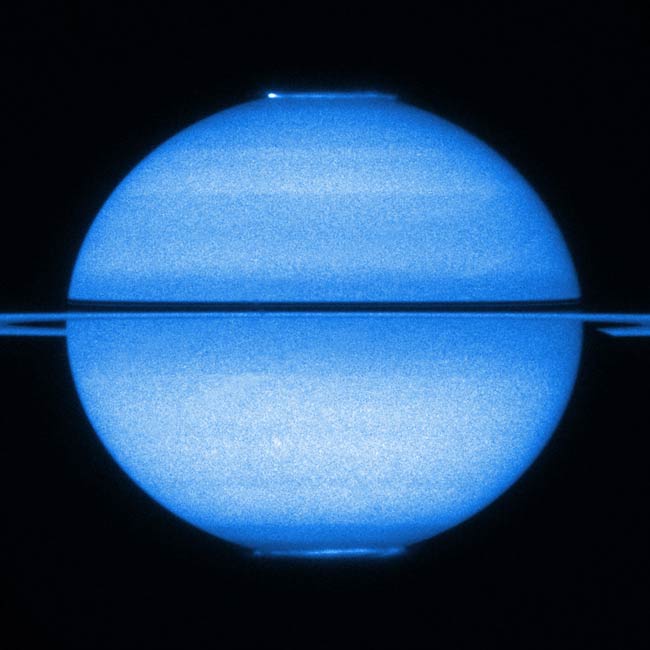
Saturn's auroras in time lapse sequence, taken by one of the most important science tools ever invented - ever! - the Hubble Space Telescope (HST). Fact! Every planet with a magnetic field (Earth, Jupiter, Saturn, Uranus, Neptune) has auroras. Saturn has particularly spectacular auroras, as witnessed above, and below:

Look at them! They're things - you can see their thickness in this pic. That's because auroras are actually things - particles from the sun, sent flying on the solar wind, wrapping down the magnetic field of the planet towards both poles (due to the shape of spherical magnetic fields - everything is geometry, someone once said).  Cool, right?

It gets cooler. Scientists recently discovered - and believe me, despite all the wingnuts and Heebie Jeebies, we are in a Golden Age of scientific discovery, because of our advancing technology - that the coolest moon in the Solar System - Enceladus - is electrically connected to Saturn. They form a circuit. Lookee here:
On the left is a spot just below Saturn's Northern aurora, with a stream connecting to a big spot in an aurora like phenomena on Enceladus. These two spots spin around, the proof that they are connected. Check it:
This is Saturn's Northern aurora from above - in the upper left, you see a white box with a red dot in it. The red dot is the electrical field of Enceladus, as you can see it move in this time lapse image.There is a corresponding movement in the bright circle above Enceladus.

Enceladus is electrically charged in part because of all the water it expels. It expels a lot!  Enceladus contributes several of Saturn's rings, as it spews water into space which then freezes hard as rock then orbits around Saturn in a ring for some millions of years in beauteous wonder.

We are learning more and more about the Universe we exist in and are part of every day. It's amazing - to think! It was the mid 1990's when the first Exoplanet was confirmed, and now we are over 400 and about to sharply spike way higher - conventional wisdom now holds that just about every star has planetary bodies of some kind orbiting it. Meaning there are hundreds of billions (trillions?) of planets in our Galaxy. And of course there are hundreds of billions of galaxies. And so on.

The point? We live in a miracle. As a PS, here's humble ol' Earth, our home:
Aurora Australis, y'all.

20101115

Simulated Suffering

Sorry for the long absence! I've been exploring the concept of "simulated suffering", whereby you intentionally choose an action which causes you some suffering, in the hopes of learning/growing from the experience. We do this all the time of course, but there are degrees. And it's the degrees - and the intention - which matters.

Consider running, or jogging. I'd put that squarely into a "simulated suffering" category. You are willingly making yourself uncomfortable, in order to advance physically and mentally. That's the concept!

So, I see many people justify tattoos from this perspective - the pain of getting a tattoo makes you remember it, makes you learn the lesson you're trying to teach yourself. I have no evidence one way or the other whether this works. It might!

But I would like to describe two basic techniques (in addition to the technique already mentioned - exercise): Meditation and fasting.

1. Meditation. You might not think of this as suffering, but to your normal mind, it very much is. Meditation is suffering because the time spent meditating could be time spent by the mind obsessing about whatever is to be obsessed with that day. You are forcing yourself to not think, not talk, not move. These could all be considered degradations done to you by another, but because you are choosing (choice is key here), this becomes a simulated suffering. Again, the idea is by taking time each day to "suffer" - here, meditate - you come to appreciate the normal world far more. Like with...

2. Fasting. Ever gone 24 hours without eating? If you're healthy enough, I'd recommend you try it, at least once, to see what it's about. It's painful, and can be filled with real suffering. But, once done, that mountain climbed, you'll come to appreciate everything in a way you did not even realize before. You'll come to cherish that small snack you have before bed, or the breakfast that is made for you, or the nice lunch near the park...


And that's the goal: We are living a miracle, the greatest gift that could ever be given. We are alive. Yet! The vast majority of us utterly take this for granted, and instead focus on whatever pathetic delusions we've created for ourselves to whine and moan about. It's obscene - but I do it too! We all do.

So, the work is: Take yourself out of your normal perspective, intentionally put yourself in a different perspective, and see what you learn. Do this often enough and it becomes habit. Once it becomes habit, it is you. 

I challenge you to think of ways in which you might implement this thought in your own life. What "simulated sacrifice" can you come up with?

The best example of this of course is the "You don't know what you have till it's gone" School of Living, wherein when you are sick, you can think of nothing else but how wonderful it is to be healthy. But when healthy, you rarely give it a moment's thought, right?

We must realize this miracle as an everyday experience. This is one way to get there: Make yourself suffer - within bounds, constructively, for a purpose; but suffering all the same. Because as far as I can tell that's the only way any of us learn.

20101022

The Point

I realize all this science stuff ain't everyone's cup o' tea. "Boring!" You might say. "Bring on the pics of monkeys riding in kangaroo pouches", others might proclaim. And I agree with you all! To a point. This blog, however, is big, and all encompassing. There's really no limit to my interests - pray I don't bog down in financial derivative chat!

But, my point through this last series of posts is to really lay out a vision on Perspective. You'll note that Perspective is one of the main themes of this blog. It determines everything, since we are bound in a series of systems which by default sets certain perspectives on us - our senses. For example, we are evolved to see in a small sliver of the radioactive spectrum - what we call "visible light". But that's just the way it worked out. If things had gone differently, perhaps we could also see in infrared, or ultraviolet, or in radio waves. And if that were the case, you, me, and everything we humans have built would be dramatically different. Probably no humans, for example.

So, through these last series of posts, I have gone from the smallest of the small - the quark, and the theoretical particles that might make up quarks, and the theoretical strings that might make up these particles; through protons, atoms, molecules, chemical compounds, higher and higher up the chain of existence, of complexity, to life itself; and then onto the general environment we find ourselves - citizens of Sol, our Star, re-giver of all the energy we see around us. 

Then we moved on past our star to the galaxy of stars we live in, and the wonders/terrors present in neutron stars and black holes, and finally onto the idea of the Multiverse, or even a Multiverse of Multiverses, scales of existence beyond our ken, and our Barbie.

And through it all, I keep highlighting the idea of "phase changes", for the simple reason that there is no binary, no on/off switch for anything, but rather, everything exists in a continuing spectrum of existence, crossing dimensions, spacetime, cellular boundaries, you name it. Remember: E=MC2, and thus there is no dividing line between energy and matter, but simply phase transitions between different states of existence - like ice turning to water, turning to steam, turning back to water, turning back to ice, and so on. No energy is ever lost, nor created - just transformed.

This is the reality we find ourselves, trapped really. Except we have one thing that nothing else on Earth has: Minds that can reach outside our bodies, outside our senses, and transport ourselves to completely different realities. Einstein was daydreaming on a bus when he came up with his first major breakthrough, and all of his major breakthroughs happened quite quickly in the "miracle year" of 1905.  In that one year, Einstein re-wrote our entire Universe, and moved us from creatures largely determined by our senses, to creatures that now can look past our noses and perceive the true wonders of existence - like the Multiverse, for example. Yes, Einstein built on all the work from his predecessors, and he would not have been able to accomplish what he did without them, but his revelations were truly revolutionary. He in fact took us to another level of reality - a reality beyond our senses.


And that's where we are today, cautiously wading out into an unknown ocean that often seems counterintuitive - for example, time moves at different rates depending on your speed. Weird, huh? And now that we've entered this new reality, the revelations are unfolding with greater and greater speed - it's been said, for instance, that the past 20 years have been the golden age of astronomy, such as with the discovery of exoplanets, black holes, infant galaxies, etc. 


And it continues. For example, a current theory posits that everything you know, our very Universe and everything within it, is a hologram from a higher dimension. It could be true! And perhaps we'll find out soon enough.


Regardless, the vistas that are now revealed to us are so breathtaking, so enormously vast and mind boggling, that I approach it all with the sense of the mystic: These great mysteries can be understood, but it requires one to give one's self over to the idea that everything you think you know is not the full story. In fact, it's just the surface, and beneath that surface, wonders await. Wonders that make the miracles of the Bible seem as card tricks. It's your job to dig, and keep digging, always.


And this is where I am driving all of this: The merging of science and wonder, of knowledge and faith. Faith IS important, it's just almost always misused, corrupted, or otherwise an excuse to refute knowledge. But faith and knowledge are not incompatible. I approach the Universe with Faith, since for sure, I'll never understand more than an iota of it; but! I have faith there is a System, and that system CAN be understood. Eventually....


I also am inspired by how often scientific revelations accord with Buddhist philosophy. When I first heard the phrase "Form is emptiness, emptiness form", I took it from the nihilistic perspective - nothing matters, man!


But now I see precisely what it means: We are - Literally! - empty. Atoms are 98% emptiness. We never touch anything, ever (what we think of as touch, as solid, is really the electromagnetic fields of the atoms which compose us). The galaxy is vastly empty, yet filled with everything. But underneath everything is something else, and underneath that is something else, and so on - all the way down, all the way up. Again, nothing you know in this world is as it seems - it is in fact far more miraculous than anything we could ever dream of.


And yet, still, we suffer with our petty hates and biases, bogged down by our various ignorances, ignoring the miracle which is our very existence. It's sad.


But there's always hope. Through Preachin' the Word, of course, no matter how difficult it can be to get the point across.


And finally, I find all this stuff sexy as hell. These fine ladies no doubt agree:


Peace out, y'all. 

20101020

The next link in the chain

Our sun, again. It's pretty big, eh? But not really - in the grand scheme of it all, our star is pretty average in most respects, which is a good thing. Because stars get a lot, lot bigger. For example:
 And that's big. Stars of this size burn hot and fast, living only a fraction as long as our star. Stars of this size play by some different rules. For example, their fusion process is different:
 Big stars were far more common in the early universe, and it is the big stars which made ALL elements in existence heavier than Iron (and a great deal of the iron too). For, you see, Stars are alive in the sense they are born, live (by burning - a hallmark of all life), and then die. Here:
 Fret not - our star is not going Supernova. Rather, it will puff up, eat all the planets out to Earth, and then shrink way, way down to a White Dwarf, and remain like that for billions and billions of years. The big stars, however, cross a threshold - a phase change, if you will, going up the chain (of temperature/pressure). As you can see, based on the size of the star, when these big guys go, they end up as a Neutron Star, or a Black Hole. More on Black Holes in the next post. 
  A neutron star is an exceedingly strange thing. First, they only come about when massive stars explode, and the remaining core shrinks down to the size of Manhattan. However, this small space contains an ENORMOUS amount of matter, so dense that a teaspoon of it would weigh more than the entire Earth. A neutron star has a solid crust, of Iron - how strange is that? It experiences "starquakes" on its surface, just like earthquakes, but on a scale beyond comprehension. But I am most interested in the interior, for, from what I can gather, the center of a neutron star sits on a line of reality - on one side is our universe, filled with energy, matter, stars, planets, etc; on the other side, is the Singularity of a Black Hole, which no one really has any idea about.
Neutron stars can go by a couple of different names. They're also known as Pulsars, due to the two jets of matter spewing out from the poles. They're also known as Magnetars, due to the incredible magnetic fields generated by this much mass/energy contained in such a small space, spinning incredibly fast. Again, the neutron star resides on the line between our reality of gravity, and the gravity of a black hole (which is "infinite"). 

My point? This line, of creation/destruction, reality/some other reality. There is so much mystery here it boggles my mind. Think of the processes involved: There was the Big Bang (another huge mystery) which produced the raw materials for everything; this material cooled over time, forming matter through phase changes; this matter aggregated, and eventually formed the first atoms (hydrogen and helium); these atoms coalesced into humongous clouds that blanketed the entire universe in darkness until, due to the vagaries of time/space, one very, very special cloud got very dense, and more matter was drawn to the center, making it denser, and so on; it began to spin, and draw in more matter, until BOOM! The birth of the first star, powered by an engine of creation hitherto unknown in existence: Fusion. Then another star was born, and another, and a million billions others. All huge, gigantic stars that burned hot and fast, and then exploded, seeding the early universe with all the elements we know today, and providing the material for the next generation of stars (ours is 3rd generation, I believe).

But they also left behind Neutron stars and Black Holes. Which might appear to be destruction incarnate, but really became the gravitational loci of the newly forming galaxies - our ultimate homes.

So, once again, over and over and over again - creation = destruction. All opposites are the same. Binaries are illusions. Yadda Yadda. In other words: We live in a constantly unfolding miracle that we barely perceive or understand. I find it inspiring, since there's so much more we can know. About the universe, and thus about ourselves (we are made, LITERALLY, from the material ejected by a Supernova).

And oh yeah, here's an actual Neutron star, viewed in X-ray:

20101015

Phases of everything


As the charts above show, phase transitions are the result of changes in pressure and temperature, and what they actually are is a re-ordering of the internal structure of the molecule/element in question. What we know as "solids" are densely packed, ordered collections of atoms; liquids less so, and gases the least. This is the explanation of what you see with your own eyes - the changing internal structure.

As the temperature/pressure goes up, matter starts to break up, and if given enough heat/pressure, it will in fact cease to be matter, converting (or phasing) into pure energy (E=MC2).  And here comes my big point: Everything you see, know, are, is the result of a phase change that occurred early in the creation of our Universe. Lookee here:

Click for big. What this diagram is in fact showing is the phase transition of pure energy into matter - a distillation, if you will. From the starting point of inconceivable temperatures/pressures, everything since has been getting cooler and less dense - expanding. And from this cooling, matter formed, like ice emerging from water. We're the ice. And not just matter, but the fundamental forces of our existence - electromagnetism, for example.

There's many cool things to point out here. For example, for every particle of matter created, there was a particle of anti-matter. These particles were created, collided, and destroyed each other. Over and over and over again. Somehow (no one quite knows) though, as this matter/antimatter collisions occurred, there was a small remainder of matter. All matter in the universe today is that remainder. So, consider - the slight imperfection of the matter/antimatter conversion resulted in a small amount of matter left over, and that's our entire reality.


Look above up to the 300K year mark. The universe up to this point was hot, busy fog - light could not escape anywhere, due to the enormous amounts of particles everywhere. Atoms could not form for the same reason: everything was too hot and bothered. But with further cooling, further expansion, atoms finally formed, and when they did, almost instantly across all of creation, the fog lifted, and the Universe was transparent, but filled with vast clouds of gas.


And almost entirely dark, for there were no sources of light other than the photons randomly cast off by the "getting rarer all the time" collisions of particles. This period is called the Dark Ages and we cannot see past it through our telescopes. But then something truly magical happened: the first star was born. Here:
I think this is incredibly beautiful when pondered: the first star. There really was a first, and quickly followed by many, many others in a chain reaction of creation - the so called "reionization era". These first stars were huge, and burned very hot, and died quickly. In these first supernovae, the first black holes were created. These black holes in turn helped create more stars, and more importantly, served as the rotational centers of the first galaxies. By the end of this process, the Universe looks the way it does today, filled with bright stars, swirling galaxies, and panoramic nebula. And lots of dust.


So, the next time you're stuck in traffic, or in the office, step back from the moment and consider that you, everything around you, all that you could ever know or be is the re-working (many, many times over) of the initial energy from the Big Bang. In fact, we ARE the Big Bang; everything is an expression of this moment of creation, a phase change from the moment of conception to the "freezing out" of matter, which then in turn formed stars and everything else. Including you (we ARE star dust, literally).


Awe inspiring, eh?

20100917

Saturnalia!

This amazing picture (click for big) was taken by Cassini, which is currently orbiting Saturn and has been for some time (originally launched in 1989!). It shows a remarkable phenomena - a solar eclipse, except Saturn is the Eclipser, rather than the familiar Moon.

Amazing fact: It is pure co-incidence that we see full solar eclipses on Earth - no where else in our Solar System is it possible, and maybe no where else in our Galaxy, or heck, even our Universe (though I doubt that)! The lucky break is the moon is precisely the right size in relation to its distance to the sun to completely block out the sun when in eclipse.

Alas! The Moon is moving away from Earth every moment - about an inch and half per year. Consider! The Moon is 5 feet further away now than in 1970. Amazing, eh? Give that a few million more years, and eventually, the Moon will be so far away we will no longer get full Solar Eclipses on Earth.

So! Enjoy it while we can!

20100621

Everyday Miracles

Nothing special here, right, just some stupid leaves. But think about it for a moment(s), and you can quickly see how even the most mundane thing in this world is in fact miraculous.

The light you see here - which in fact powers just about everything on the earth - is millions of years old. Sunlight is only generated at the center of a star, where the fusion is taking place. Light is a by-product of fusion. But it is so dense at the center of a star, the light cannot easily escape, so it spends millions of years trying - bouncing hither and yon, thither and gone, over and over again till one day some lucky series of events happen to allow it to escape.

Once this photon of lights escapes from the depths of the star, it moves at light speed, and takes about 8 minutes to reach us from the Sun - fun fact! The sun could be destroyed right now and we would not know about it for 8 minutes.

Light really does power just about everything here, in one manner or another (the correct way of stating this is energy from the Big Bang powers everything; however, semantics be damned!). Witness the other obvious miracle here: Life, specifically photosynthesis. Converting sunlight directly into energy, and releasing Oxygen as a waste product.

Oxygen, one of the key requirements for the rest of life. Hmmm.

And so evolution - only through time, mutation, and competition - fashions lifeforms that can survive in the given environment. Plants were the first complex lifeform on the planet, and the atmosphere at the time was filled with carbon dioxide, so they use carbon dioxide. The amount of oxygen we have is mostly due to the success of plants - we breathe plant farts.

Or consider eyes - wondrously complex sensory organs. Plants don't have them, but don't really need them either, ja? Their entire bodies function much like eyes. Our eyes - human eyes - are not human at all, but the net result of millions years of mammalian evolution. We just look real good with them.

But consider what your eyes see when they "see" something - what you are witnessing is photons from the sun (or another light source) striking the object, and some of the photons bouncing off, and hitting your eye, where they in-turn are absorbed as energy, and their frequency is then translated by your brain into the image, and its specific color, brightness, texture, etc.  Consider! When you look at the moon, what you are experiencing is millions of years old photons, created in the fires of nuclear fusion, bouncing off the moon at a precise angle, and striking your eye, where your wonderfully evolved brain translates these data streams into.... the moon. Or a leaf of a plant.


Pretty miraculous, all of it, eh?