Pages

Showing posts with label asteroid. Show all posts

20130713

Satire Not Satire

The top picture is from the Dave Chappelle show (which was hilarious). The bottom shot is a real screengrab from Fox News. Hilarious, and depressing.

Let's call it "The Onion-Poe Theorem": As time progresses, Fox News will grow increasingly indistinguishable from The Onion. When the two are 1=1, The Wingularity is upon us and there is no escape from certain DOOM.

20130611

Shells

Let me drop some more perspective on you. Here's our old friend, the Oort Cloud. Picture billions upon billions of icy little comets tumbling around in a vast sphere, such that our entire solar system is enshrouded in a cloud of ice. A shell, like the electron shell.
It's big - extending almost a light year in all directions from the Sun. And then as you see, far closer in, is another sphere, or shell, of icy bodies, but also rocky bodies too - like Pluto. The Kuiper Belt, another shell - also like the electron shell.

So again picture this from far away in space, looking towards the Sun. First a giant cloud of white ice, floating lazily in a vast sphere. And another sphere of ice and rock far within that, and then tucked inside that shell are planets, and a star.

Every star with planets probably has something similar. And so now look up into the dark sky and picture every star you see as a white egg of ice shells, within beats the bright nucleus of a galactic atom. Together these atoms join with vast clouds of gas to create galaxies, and galaxies join other galaxies strung along in necklaces of dark matter, grouping in vast clouds of millions of galaxies, stretching.... forever?
Is a shell forever?

20130327

To Date

 As always, click for big. This is, in the new, hip style, an infographic of every mission beyond Earth. You can see where we (humanity, meaning mostly the USA, USSR, and the EU) have collectively put our priorities, to date. My big takeaway is look how few missions to Saturn there have been, and yet one of them - Cassini - is incredible beyond belief. And still going!

Fret plenty, however, since as Russia has taken a nosedive, and America's looking to do the same, who knows how many future missions to space at all lie in our collective future. I fear perhaps we are on the edge of a rollback of human progress. Maybe China will save us all. Maybe not.

But, let us not worry about that now. Instead, behold, every single human rocket:
While impressive, collectively and each in their own way (think of the effort that went into every one), it's also mildly depressing. It takes so much effort to simply go the 60 or so miles (straight up) to get to the very edge of space. Alas! Such is the reality of living at the bottom of a gravity well.

And perhaps there's more hope for our future than I admit, at the moment. Private enterprise is blazing paths governments feared to tread. If the profit is there, and our infrastructure on Earth stays relatively stable, we might still have our space mining, asteroid living future. But then, it will be profit driven, and no doubt that asteroid will be owned by Yoyodyne or some such, and all the folks involved will be playing according to their dime. Which can be summarized in the Ferengi Rules of Acquisition, and not in any kind of Utopian Trek "What's money, man?" Directive. And so we'll simply export our Dystopia to space.

Alas!

20130326

Asteroid sweet home

IF - that's the BIG IF, by the way - we manage to actually start mining asteroids in space, a logical leap would be to use the asteroids themselves as bases. Consider Ida, below. You could use Ida as the base, and mine Dactyl. Why not? You're already digging, you've got raw materials, water, air, energy, and perhaps most importantly of all, the interior of an asteroid would provide perfect shielding against radiation - something we have little hope of stopping with our current or even near technology.

It would start small, of course, with the space miners themselves living in some burrowed out cave, but with time, and effort, and the fabulous gazillions of dollars space mining will create, things will get bigger.
And groovier.
Check out future space plow, and the old asteroid fishing hole. But bigger still - really, the scale would only be limited by available asteroids. And not just for habitats, but for space ships:
And why not? Once you're in space, mass doesn't matter so much, and there's no aerodynamics to worry about. Thus:
To the future!

20130325

Asteroid's got a Moon

Here's the asteroid "Ida" (31K diameter) with its very own moon, Dactyl (1.4K diameter). Coming at ya live!
That Ida has a cute little moon gives scientists reason to believe many/most larger asteroids have moons as well, since, as the idea goes, debris is scattered around the asteroids often enough, and it's more than likely some of this debris will form an orbit, at least for awhile.
Here's tiny Dactyl, cutest li'l baby moon of Sol's System!
Once again, just for perspective, there's more accessible metals and precious stuff like gold on rocks like Dactyl than ever dug up on Earth, for all of time. Just waiting for us out there. Or, conversely, on an eventual collision course. Either way, we're rich!

20130323

Our only hope

As I've said many times right here on this here blog, a large asteroid strike on Earth is inevitable, and when/if it hits, most life on Earth, including all human life, is done. It will be something like a 90-96% extinction rate of ALL life on the planet, including bugs and bacteria and slimy stuff swimming in the seas. Consider this danger deeply, for it's very real. Here's but a taste:
And these are just the ones very close, and none of them are very big, and we're missing many, many smaller ones - the 150 meter ones mentioned below, for example. Large enough to cause widespread chaos and death on Earth (though not an extinction event). Asteroids vary greatly in size:
Vesta is bigger than many moons of Jupiter and Saturn, but not the biggest asteroid (that's Ceres, where the Dawn spacecraft is heading as I type). However, asteroids the size of Steins and even smaller are our real threat. Look how tiny! But big enough to kill us all. All it would take is 5-10 mile wide asteroid to do us all in.

And what could we do about it today? Very little if on short notice. If with 20-30 years to prepare, we could probably save ourselves, starting from scratch. But why start from scratch THEN, when we all know the answer TODAY?!
Figuratively, of course. An armada of Asteroids fighters flying around space blasting rock is not very likely.
Sad, I know. Believe me! I'm the best Asteroids Ace you've ever seen. Go ahead and try your skills here.

But no, it won't be people in triangular spaceships that save us from the asteroids, but rather small robotic spacecraft that can attach to and then redirect these Earth impacting asteroids. Imagine 50 small bots flying to then landing on an asteroid on a direct impact course, each using its rocket to steer the asteroid in a different direction. It don't take much in space.

For your regular asteroids. If a Vesta like object were coming at us, better to move off planet. Here's a closeup from Dawn:
"The Snowman".

Once again, people of Earth! Rather than a'fuedin' and a'fightin' with each other, we should instead be building a space infrastructure that 1. Enriches all life on Earth, 2. Protects all life on Earth, and 3. Spreads life from Earth.

We're all Pro-Life, right? Let's get it together, humanity! As we're the only ones here who know better. We cannot count on the other monkeys.

20130322

Sky's not the Limit

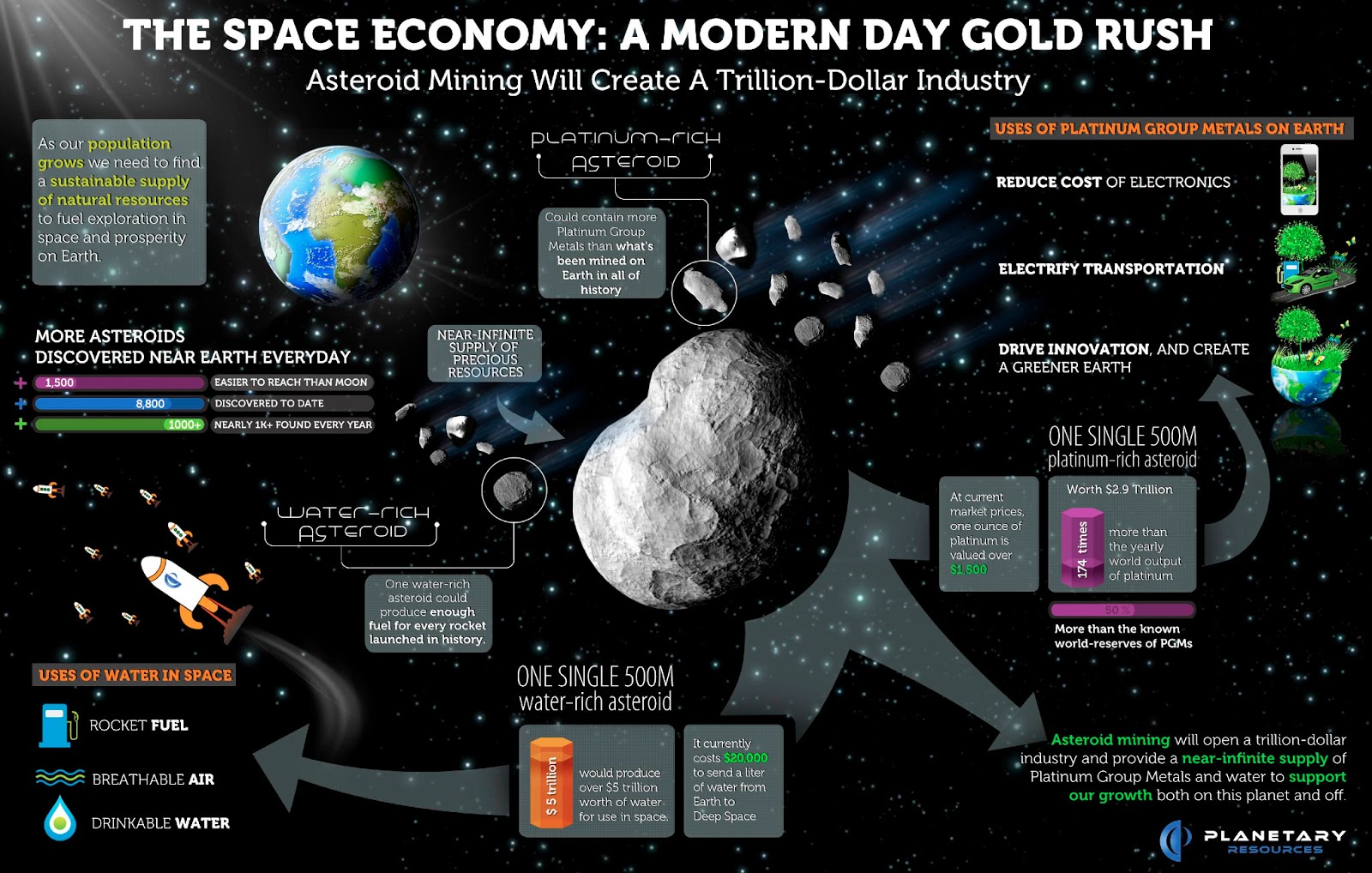
Click for big - Asteroid mining as a maybe real thing by some rich dudes who've started a company. If you're super rich, why not? And if the crazy idea actually works, well, then you might become the richest men who've ever walked this precious metal barren planet. Richer than Crassus.

For you see, Earth differentiated - meaning, it melted. And most of the heavy stuff sank down deep into the planet. Far from our machines. And so we simply scrape around the surface - all the gold, silver, tin, iron, etc ever dug up but a pittance of what actually exists on Earth. But we'll never be able to get to it.

And so, space. Most of the time asteroids did not differentiate, and thus the precious metals are sitting in discrete chunks close to the surface. Some asteroids are almost entirely iron. More metal than mankind has ever know sits in just one or two 500M asteroid. Read this if you can:
I'll summarize the entire idea (which will eventually happen if we continue to advance as a technological species): 1. Find some good target asteroids. There are two general classes - water rich, and metal rich. 2. Get to them, and drag them to a Lagrange point. 3. There, mine them of water and metals. 4. Send some of the metal back to Earth for a very large price. Use the rest to build your space mining infrastructure to you can mine ever more asteroids.

Soon enough with this scheme and we'll have entered some post-scarcity wonder world of flying cars and giant space stations.
Also too: Underground cities in case some mad Gazillionaire decides to rain asteroids down upon the planet.

20130228

In a saner world

Thank you Russian dashboard cams! The best recorded meteor event of all time happened recently, and should be a wakeup call for us all. This tiny piece of rock - which explodes as you see above - caused fairly extensive damage over the city below mostly due to the pressure wave of the explosion, which blew out windows and knocked down some rickety walls.


And this was just a tiny rock. Here's (possibly) the final impact spot:
Get some learnin' in slick modern inforgraphic form!
Click for big. The takeaway lesson here, friends, is we are in great peril. From a variety of sources. Meteors/asteroids are one of these threats - and something we could do something about, if we had the collective will. And we should - it is INEVITABLE that a large rock will hit the Earth again and send everything into collective turmoil. This has happened many, many times in the past and WILL happen again. Only a question of when. We might be able to see it coming, but we might not. Isn't the entire existence of humanity worth trying to protect? I think so, and so look forward to the day the leading nations of Earth agree to jointly fund a peaceful program of monitoring and engagement of space rocks.

Bonus extra feature: Space mining. We could make it happen right now, if we wanted to. But I guess we (some) don't.
Vladimir's ready to save the world!

20121226

Begin the Begin

This was the picture in my first ever post on this olde blog, so many (4.5) years ago. I post it again because it fits the theme, it's awesome, and as a symbol of the new year.

Opportunity spotted this almost pure iron/nickel meteorite near its landing spot, and so dubbed "Heat Shield Rock" by NASA wags. Lame. But the meteorite itself is incredible - consider that iron meteorites are far, far rarer than stony meteorites, for the simple reason that an iron meteorite only comes from one place: The core of a differentiated planet. This planet of course was destroyed, a small piece of its core sits on the surface of Mars, right beside Opportunity. The odds!

Longtime fellow redshirts might recall that I have a bit of a love affair with Iron - the chemical substance. Fe 26, yo. It is only created in one place - a star. Either in the core of a huge star and as that happens, the star soon explodes, spreading the Iron hither and yon. In that explosion even more Iron is created. And every bit of Iron you know of - including the Iron in your blood (think about that, man) - came from an exploding star. This Iron now scattered to the four corners coalesced with clouds of hydrogen and helium and other gases, which if lucky began spinning fast enough to create a new star, with new planets - all of which will have Iron cores. Iron lies at the root of all creation, and destruction.

For it's true! Stars happily chug along creating all the elements up to Iron, glowing and casting their life giving light across space, and onto many, many exoplanets and exomoons, but then as soon as a star produces Iron in its core, it's doomed. So Iron is the end of the fusion line, and literally poison to stars. And yet, on the other side of the scale, all the higher number Elements - like gold, silver, plutonium, uranium, etc - all decay, over time, to Iron, and in so doing cease being radioactive. In fact, a definition of "radioactive": anything higher than Iron on the Periodic Table. This decay will take trillions of years, but eventually there will be a time when all higher elements have decayed to Iron, and lo, that will truly be the Iron Age.

Iron is literally - and figuratively - the balance point of creation, of our very reality. Everything we know of is made up from Elements (which in turn are made up of combinations of electrons, neutrons, and protons, which in turn are made up of combinations of quarks, which in turn, current theory posits but has not proven, are made up of combinations of preons, and I'm sure there's some other turn to be discovered in the future), and Iron sits in supreme harmony among them, destroyer and creator, ultimately, of all.

Yay, Iron!

Also, kudos to you Opportunity - you rule. But let's also pour one out for Spirit:
NASA lied to the rovers, of course, the cold hearted bastids.

Bonus Spirit pic, snapped 3/8/04:
Earth, as seen from Mars by Spirit. I'm on "Team Spirit" in case you couldn't tell. Opportunity's awesome and all, but too obsessed with being cool and down with the "in crowd". Spirit would talk to goths, for example. Also understands mortality, as any good redshirt should.

And so with that, I begin again. As we all do, every day. But some days more so than others.

20120615

Taasty Braains

Mmm, brains. So sweet and tasty. For a zombie, of course, but how 'bout for you? Ever eat brain? Some folks have, all fancy like no doubt, and in the past (way back) most folk did, I reckon - would you pass up any food in 26,000 BCE?

This is a thing, by the by - brain cupcakes. Ask the Great GIS, you'll see. And I marvel at it, as I do all things ridiculous and over the top and just plain wacky, for it is in our creative frivolity when we are most human, aye, when in fact we define humanity par excellence. For it is in luxury, splendor, absurdity that humanity is defined apart from all other life, cuz seriously, what other form of life could even conceive of brain cupcakes?

So I see it too with vegetarianism, also by the way. It's a luxury, a decadence for a scavenger species. We are so well off as a species that I, vegetarian, can forsake biology and evolution and forge a new path, one arguably more healthy and beneficial to the Earth as a whole, but still, a luxury. For when that asteroid hits and sends our planet into decades of darkness, I would not refuse a bite of jerky or hard tack, or even fresh brain. Calories would be all that matters, then. Now? Choice.

And it is in the choosing we are human - in the luxury of choice.

20120412

Committed

Fervor and commitment create the same in others, spreading like fire and thus culture is made, over time. The inspirational nature of the spiritual occasion gives it more or less power, so you better put on a good show. Pass these lessons on and let them cook in the oven of time and voila, Religion.

Also, I am dreading the inevitable increase in "WORLD TO END 2012 MAYA APOCALYPSE REPENT!!!" talk. I saw an ad for Ameritrade or some such investment company and they directly referenced 12/21/12, the DAY OF DOOM. Reversal of gravity, apparently, which would actually be an awesome way to end the world. But it's not going to happen!

I once dabbled in 2012 dreaming, having read all about the Mayan calendar decades ago. But back then, no one else much knew, so it was cool. But now? LAME!

No, now I know and understand Science, and thus have moved past all mythological answers to real questions. The world might end on 12/21/12 - but it could also end tomorrow. Or a billion years from now - it will end one day, our world at least. An asteroid, a volcano, a cosmic ray, lots of ways. But I bet it won't end on 12/21/12 and if by some strange chance it did, that still proves nothing about Mayan religion of Gods. It might speak to their astronomy, however doubtful.


But! The very idea of it - and this meme has grown wings and will soar ever higher in the sky as we approach the dread date - aye! This very idea will be self creating, as lost, lonely people latch onto it and try to make it real. Hoarding, looting, general mayhem could happen as fear mongers in the media ratchet up the tension.

Wait and see. I had a vision.

20111231

New Year's Eve in the Dawn of Apocalypse

Happy New Years! One of my favorite holidays, tainted only by the fact it's based on a Christian calendar. But I can rise above that. Of all the holidays, people are most open and friendly on this night, willing to kiss strangers in the Common - when else does that happen? Mardi Gras in New Orleans, perhaps. The best night - Halloween might run some competition, but it gets a little too serious and demanding. New Year's is all about the part-aying. But don't drink and drive kids! Except on rural country roads, then it's cool.
And why not drink and drive? We've got less than a year left before the dreaded MAYAN APOCALYPSE! December 21, 2012, and the World ends, by some means which is not clear. But there's a cosmic alignment involved for sure. So feast and and be merry while ye can, for surely DOOM is nigh.
I'll admit I used to half believe in this Mayan Apocalypse bullshit - but it was a long time ago, 1998 or so, and I happened upon a Weekly World News article that was quite convincing. After further research, it seemed likely the world would end in 2012, due to a MAGNETIC POLAR SHIFT.  Because it's true, the magnetic poles on Earth do shift on semi-regular schedules, with North becoming South and South North. Think what that would do to our electronics were it to happen? Frazizzled.
There are lots of ways, in fact, our World (that being our human existence, and not the World itself) could easily end, tomorrow in fact. Herewith is REDSHIRTS TOP TEN APOCALYPSES (not in order):

1. Asteroid Impact. This is inevitable. It will happen at some point, the only question is when. Tomorrow? A million years? Sometime in between? Who knows. We might have years of warning, or, even with our awesome technology, a killer asteroid could sneak up on us unawares and be on our doorstep in days.
2. Super Volcano. Also inevitable. There are a dozen or so super volcanoes on Earth that when they explode, are powerful enough to darken the skies with ash for years. Can you imagine how tough it would be to live on this planet without sunlight for 10 years? We'd starve.
3. Nuclear War. The most likely doomsday scenario. All it takes is some dumb Repuglican with his/her finger on the button and we're all doomed.
4. Solar storm. Also inevitable. Our reliance on electronics would cripple most of so called "modern" society. If strong enough, could toast most living things.
5. Gamma Ray Burst. If a star of certain mass goes supernova and happens to have one of its poles pointed directly at us, we could be in the line of a sight of a high mass, super powerful gamma ray burst that would fry most life on Earth.
6. Global Warming. Happening right now. The real deal and we'll find out how well we can deal with Change - no thanks, once again, to Repuglicans, the crazy fucks.
7. Magnetic Polar Shift. Also inevitable. An event that would have zero impact on a tribe living in the Amazonian rainforest, but which would devastate "modern" society.
8. Ice Age. One of the consequences of global warming could be a new ice age, ironically. Snowball Earth would freeze most life to death.
9. Geologic Instability. Also inevitable. Imagine all the plates of Earth undergoing a vibratory effect that levels anything over 30 feet tall.
10. Super Virus. A bacteria that proves lethal to any human that comes into contact. Easily enough to conceive of, and gosh darn we've got people researching the subject worldwide.

Scared? You should be (but of course shouldn't be). Life is a tenuous proposition on this planet, and we could be shaken off like so much lice. And so, take nothing for granted! There is nothing permanent here at all, in the least bit. Every moment is a gift and you should treat it that way. Let us pray:
Dear ambiguous New Age God, give my Chakras the Crystaline Energy to survive the coming Tribulation.

I don't believe in a prophesied apocalypse at all anymore, in case you can't tell. I worship Science now and believe you me, it's the only Faith that delivers.

20111224

Callisto or Bust

Let me start this by saying I am a huge hippy and truly believe in peace and love and all that shit. But I am also coldly pragmatic and logical. So believe me when I say IF all the nations of the Earth today stopped spending money on weapons of war and instead spent that money, or even half that money, on space exploration and colonization, we'd have Lunar bases already, and would be well on our way towards colonizing the Solar System. Instead, we languish in low orbit, reverting to baser modes down below. I would not be surprised if mankind loses the ability to get to space in the near future. But! This is not the post for such soothsaying.

Instead, let's pretend it all works out swell and humanity is united in pursuit of spreading out, and colonizing. You could start with the Earth trojans as described previously, and build out from there, OR, you could just say "F it, let's go for it" and head directly for Callisto. Here:
All those white marks you see are water ice. Water is everything, and the easier it is to obtain, the better your chances of success. There's water on Mars, but you'd have to mine for it. On Callisto, on the other hand, it sits ready to melt in gigantic ice reservoirs, there for the taking. Land a ship on one of those huge white marks and you'd have all the water you'll ever need.
Ice not only, obviously, supplies water, but it also supplies hydrogen, and that is the fuel that makes this Universe go round, and we'd be wise to use it any way we can. So in one fell easy swoopies, you've got drinking water, greenhouse water, mining water, all kinds of water, all the water you'd ever need out in space - fun fact! The moons of Jupiter contain more water, by far, than all the water on Earth. Earth is dry in comparison. And all the hydrogen you can use, which could power fuel cells, nuclear reactors, and/or future space age tech.
But that's just the start. For Jupiter has Lagrange points too - as does everything that has an orbit, to greater or lesser degrees - and they are massive. And within them, at L4 and L5, sit a mighty collection of Trojan asteroids. And within them lies all the materials humanity would need to build enough tech to completely colonize the solar system and beyond.

Callisto is the perfect base for the ultimate conquest of the Galaxy by Humanity - and wouldn't that rock? Either we establish our presence with the Earth Trojans and build huge space craft there, well prepared to venture further out into space, OR we make a mad dash directly for the greatest prize in the Solar System - Callisto - Moon of water and metal and everything we need. Callisto is the 4th moon out of the major moons of Jupiter, and this makes all the difference. Callisto is not subject to the radiation baths the other 3 moons are, nor is it subject to the tidal pull of Jupiter, and thus it never experienced gravitational heating, and also thusly never differentiated. This may sound like a minor deal, but it means in truth all kinds of major elements sit on the surface/near the surface of Callisto, whereas on a differentiated planet or moon, all the heavier elements sink to the core as everything melts. So, unlike on Earth and Mars, Callisto would present rich treasures of concentrated ore at the surface, like found with asteroids but on a much larger level.

So, Callisto sounds pretty swell, right? How about a hypothetical base:
Wherever we go in space, we're going to need to grow plants. Unless we evolve into creatures that need not eat.

What I propose: We mine the Earth trojans, building large ships and a supply chain which then feeds a line of colonization from Mars into the Asteroid Belt and settling (for now) on Callisto, and there establishing mankind's next shining star. Using the Jovian trojans for an unending supply of any and every element desired, and all the water you'd ever need on Callisto, if we as a species were ever so lucky to make a permanent presence out as far as Callisto, then truly the entire Galaxy would be our next step, and immortality as a genetic representation. And is that not the goal of us all?!

20111223

Next (Giant) Steps

You remember Lagrange Points, right? Spots of gravity around the orbit of Earth and the Sun where things are relatively still and balanced - you could just hang out at any L# spot above and be cool, but especially cool, as you see, is L4 and L5, for there lay the Trojan Asteroids orbiting about Earth and the Sun cool as could be, stationary. There for the taking.

And that's where our future lies: With the Asteroids. Some are pure metal, worth billions upon billions and billions of dollars in today's funny money.  The industrial potential of such asteroids is beyond compare - mine them in space, build huge structures in space, and so on:
From the asteroids we can build huge space machines that could do all kinds of crazy things:
Eventually we'll make spaceships of asteroids - why not? Big shield of rock with all your futuristic shit all snug as a bug inside the iron walls. The spinning of the ship will simulate perfect Earth gravity, leading to:
Living large in the Lagrange, y'all...
This is where we will survive as a species - in space, living in humongous space spheres spinning through the Black... do you think we can survive like that? I do, if we have enough ships - say a million, all sent out in different directions in space. Humans would conquer the galaxy!  And is not that the point? To spread?

We can spread as a species off this planet and into space. Isn't it our obligation to do so?

20111222

Mars is Hard

Here's a graphical representation of all missions to Mars, indicating whether they were successful or not, and if so, what type of space craft. As you can see, most missions have been failures, though the success rate has been pretty good of late. Getting better! But! These are just robots, and who cares what happens to a robot? Sending humans will be far more difficult for the foreseeable future, and ultimately, what's the point?

Mars is not enough, and it poses so many difficulties. There's no special mineral wealth, little water, lots of radiation, and the low gravity means any long term habitation will be permanent - you could never come back to Earth. Couple all that with the difficulty of getting there, and it's not worth it, at least not for a long time.

I've given up on Mars, and the Moon (leave them for the robots), as they are nothing more than stunts, and our true future lies in space itself, and with the little asteroids floating all around about it.